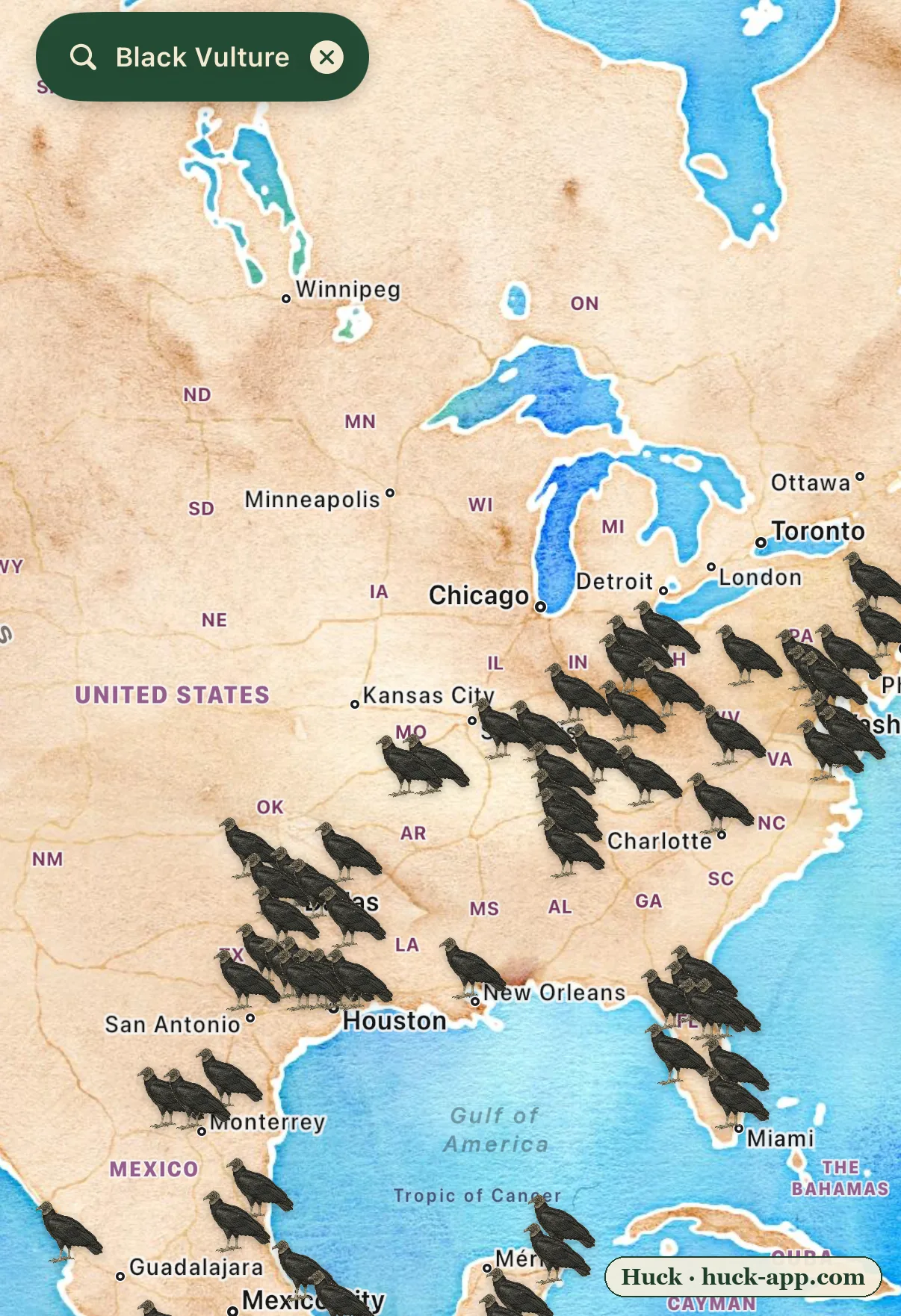
Two big dark birds circle over most of America, and from the ground they look nearly the same. They are not the same at all. One is essentially a bloodhound with wings. The other is a thief that shadows the bloodhound to dinner and then shoves it aside. The map above is the thief, the black vulture, and it is doing something new: climbing north into country that was too cold for it a generation ago.
The one with the nose
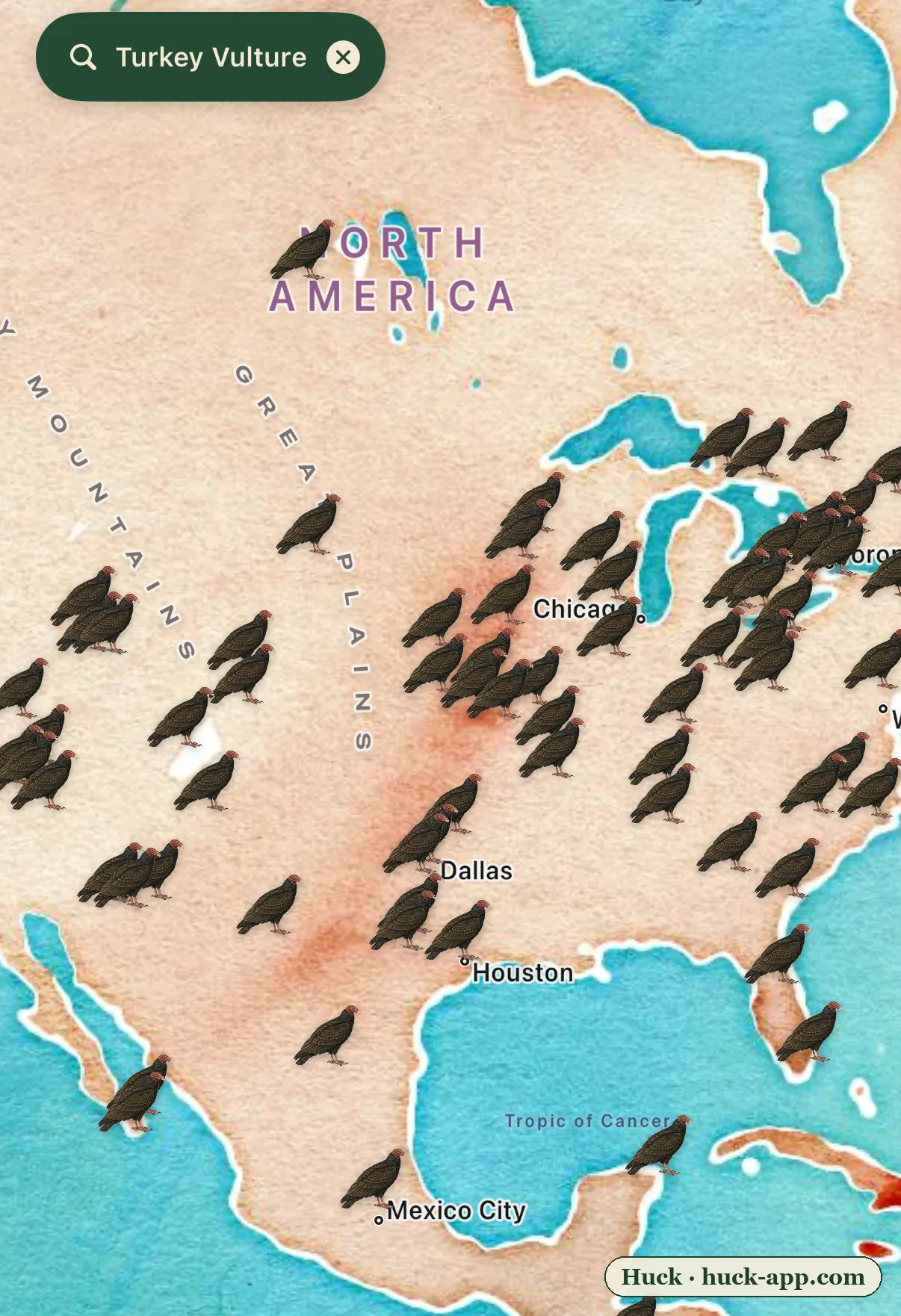
Start with the bird that finds the food. The turkey vulture, the one with the bald red head, has something almost no other bird has: an extraordinary sense of smell. It can pick up the faint gas of a dead animal from over a mile away, even a carcass hidden under a forest canopy, and it cruises low over the treetops hunting by scent alone. That nose is why the turkey vulture is everywhere. Map it and it spans the continent, from Canada to South America, filling ground the black vulture cannot.
The one that follows it
The black vulture, smaller and blacker with a gray head and short tail, is nearly scent-blind. What it has instead is nerve and numbers. It flies higher, watches the turkey vultures working the air below, and when one drops to a carcass, the black vultures pile in behind it, mob the finder off its own discovery, and take the meal. It is one of the most brazen freeloaders in North America, and it works so well that the bird with the worse nose is now the one on the move.
The line moving north
For most of its history the black vulture was a bird of the South. The hero map shows how much that has changed. Its front has pushed up the Appalachians and the East Coast into Pennsylvania, New York, and southern New England, and west into the lower Midwest, a shift scientists tie to warming winters, since cold was the main thing that ever held it back. Draw a line roughly through Pennsylvania and above it the map still goes nearly empty. Give it a few more mild winters and that line keeps climbing.
The expansion comes with friction. Unlike the strictly carrion-eating turkey vulture, the black vulture will kill, and as it moves into new cattle country, ranchers increasingly report it attacking newborn calves and cows that are down or giving birth. It is federally protected under the Migratory Bird Treaty Act, so farmers need a permit to remove one, and the conflict has grown right alongside the range. This is a wildlife story and an agriculture story at the same time, and it is unfolding across the mid-Atlantic and Midwest right now.
Why you want them around anyway
It is easy to read a vulture as an omen. It is closer to a public health service. Vultures strip a carcass before it can rot into a disease reservoir, and their stomach acid is savage enough to neutralize anthrax, rabies, botulism, and cholera, pathogens that would sicken almost anything else that fed there. Where vultures disappear, rotting carcasses and feral scavengers boom, and disease with them; India learned this at terrible cost when its vultures collapsed in the 1990s. The birds riding the thermals over the roadkill are not waiting for something to die. They are the reason it does not go on to make the rest of us sick.
What the community data shows
These maps are built from research-grade community observations on iNaturalist: about 205,000 turkey vulture records and 69,000 black vulture records, both with open coordinates, which makes them among the richest maps on this blog. Community sightings reflect where people and phones are as much as where birds are, but the contrast holds and matches the science: the turkey vulture spans the continent on the strength of its nose, and the black vulture is a southern bird climbing steadily north.
About the data
Sightings shown are research-grade community observations from iNaturalist, mapped in Huck; counts are current as of August 2026, and vulture coordinates are not obscured. The northward range shift and the livestock-conflict trend draw on reporting and research from the National Audubon Society and wildlife researchers tracking black vulture expansion.