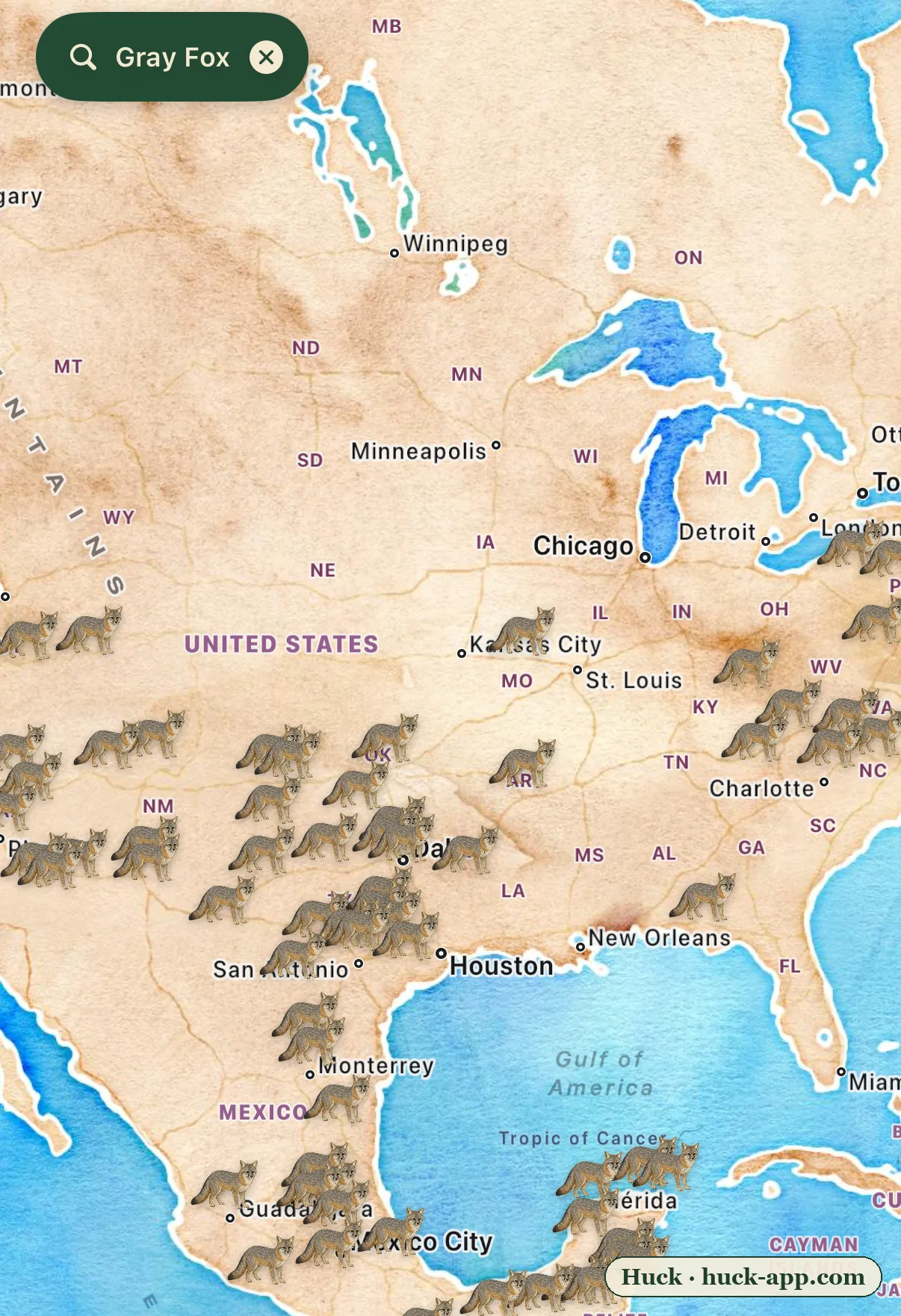
Most people picture one fox, the red one from the storybooks. There are two common ones, and the one you have probably never heard about is the more remarkable. The gray fox, grizzled with a black-striped tail and a rusty neck, does something no other wild dog in the Americas can do: it climbs trees. Genuinely climbs, cat-style, gripping the trunk with rotating forearms and hooked, semi-retractable claws, to escape a coyote, den in a hollow high off the ground, or reach fruit and birds in the canopy. The map above is where it still does that. Notice the hole in the middle of the country.
The ancient acrobat
The gray fox is not just a fox that picked up a trick. It is one of the oldest branches of the entire dog family, a lineage that split off millions of years before red foxes, wolves, and coyotes, which is part of why it kept a climbing ability the rest of them lost. It is an animal of brush, forest edge, and rocky Southwestern canyon, and its map reflects exactly that: dense through the Southwest, the Appalachians, the Southeast, and far down into Central America. But run your eye across the Midwest and the northern plains and it thins to almost nothing.
The one that moved in with us
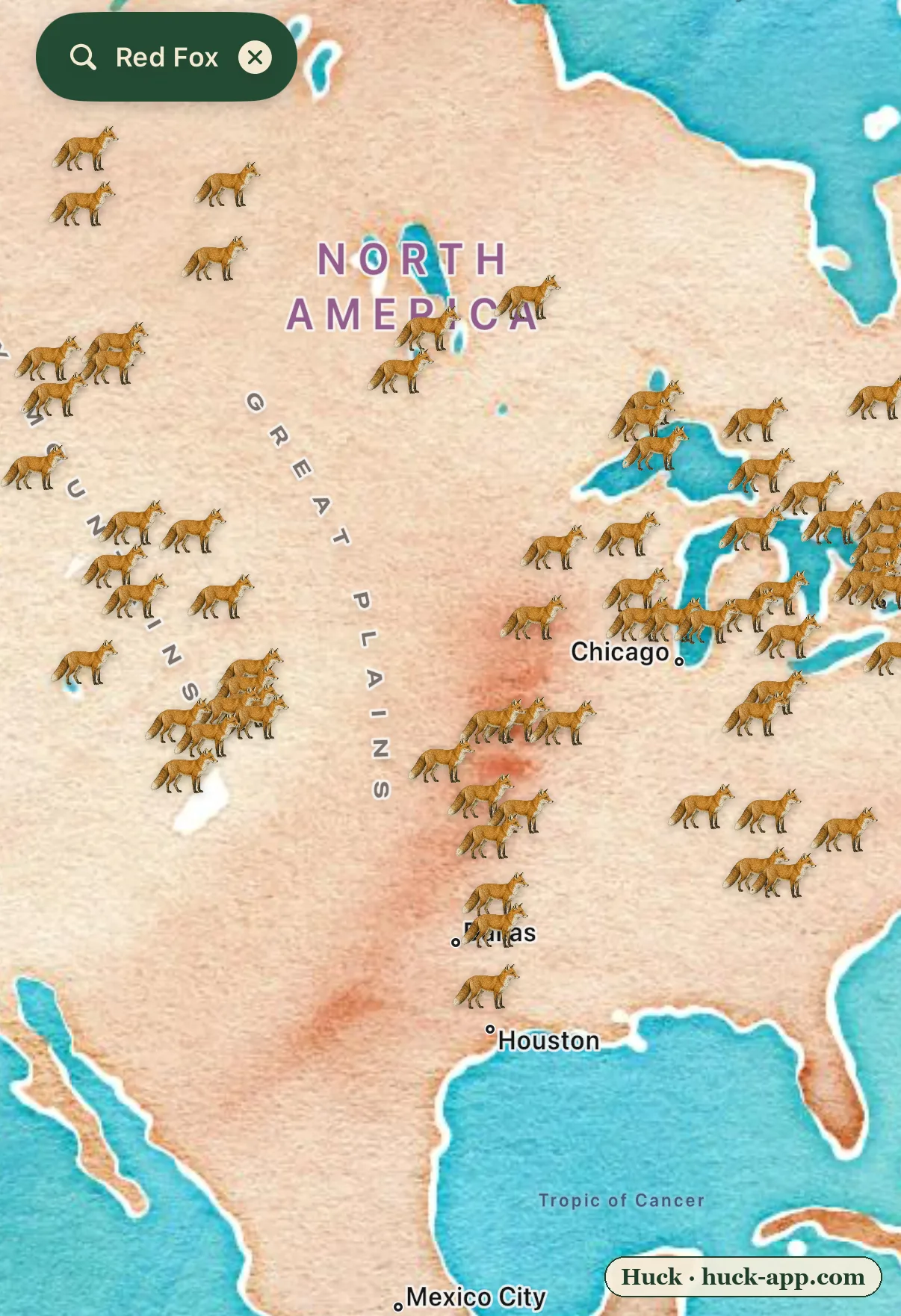
Now the red fox, and it fills the space the gray fox does not: the northern plains, the Upper Midwest, the Great Lakes, the Northeast, up through Canada, and the mountain West. Where the gray fox is ancient and particular, the red fox is a generalist that has flourished alongside people, spreading as we cleared forest into farmland and, more recently, settling right into suburbs and city parks. The two maps are almost the photo negative of each other, one fox for the wild edges of the South and West, one for the human-built North.
The trade going on right now
Here is what scientists are watching. Across much of the agricultural Midwest, the gray fox has been quietly vanishing, and recent research points to a squeeze. As coyotes expanded across the continent they became a deadly problem for both foxes, since a coyote will kill a smaller fox that competes with it. The red fox found an escape hatch: it moved in close to people, into the suburbs and edges where coyotes step more carefully. The gray fox, warier of open, human-dominated ground, did not make that move as well, and in many areas it has been left exposed, its numbers falling. The causes are still being untangled, with habitat loss, disease, and rodenticides all in the mix, but the pattern is real enough that biologists are now asking whether one of the continent’s most distinctive predators is slipping away while almost no one was watching.
Look up
It is a strange thing to realize that the fox everyone knows is the common, adaptable one, and the fox almost nobody can name is the ancient acrobat that may be in trouble. So the next time you are in Southern or Appalachian woods and something fox-shaped goes up a tree, look again. You are watching a skill tens of millions of years old, performed by an animal that is running short on the quiet, brushy country it needs, in a landscape increasingly built for its more flexible cousin.
What the community data shows
These maps are built from research-grade community observations on iNaturalist: about 33,000 gray fox records and 59,000 red fox records, both with open coordinates, which makes them among the cleanest maps on this blog. Sightings track observers too, and the red fox’s suburban habits mean it gets photographed often, but the geographic split holds and matches the published range maps: two foxes, two Americas, and a line between them that is on the move.
About the data
Sightings shown are research-grade community observations from iNaturalist, mapped in Huck; counts are current as of August 2026, and fox coordinates are not obscured. The gray fox decline and the coyote-competition dynamic draw on recent research from Virginia Tech, the University of Georgia, and the US Forest Service on gray fox population trends in the eastern and midwestern United States.