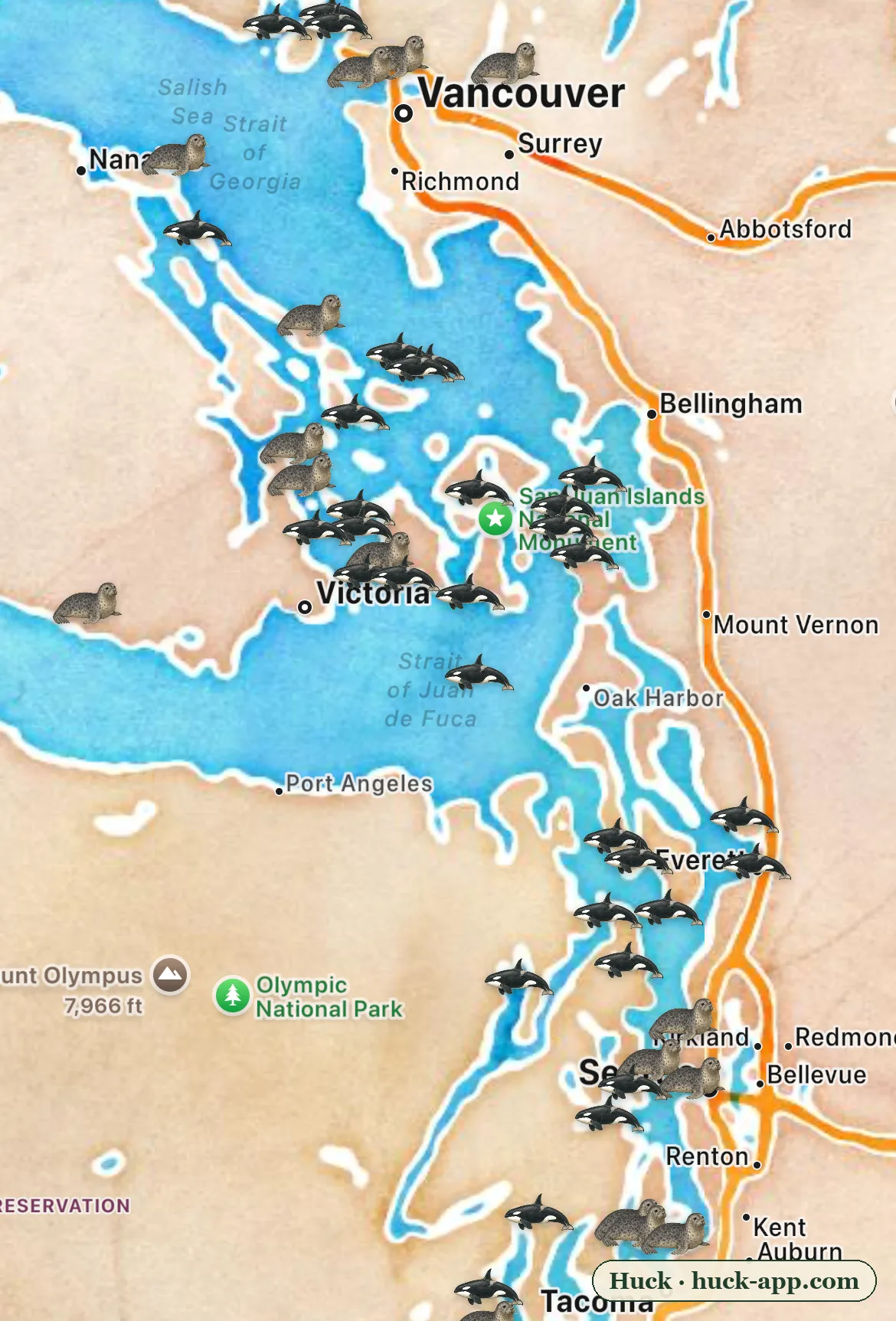
The map above shows killer whale and harbor seal sightings across the Salish Sea, from the Strait of Georgia down through Puget Sound. The seals are the supporting cast, and we will get to why they matter. But look at the orcas first: every one wears the same black-and-white silhouette, and that is the trick of it, because what looks like one animal is actually two. The orcas of the Salish Sea belong to two separate populations that swim the same waters and want nothing to do with each other.
Two nations, one sea
The Southern Residents are the famous ones: the J, K, and L pods that summer around the San Juan Islands, the whales on the ferry posters and the license plates. They eat fish, overwhelmingly Chinook salmon, and essentially nothing else. Around 73 of them remain, and they are listed as endangered on both sides of the border.
The other population goes by two names: transients, or Bigg’s killer whales, after the researcher who first told them apart. They hunt marine mammals - harbor seals above all, along with sea lions and porpoises - and they will not touch fish. The two kinds have not interbred in tens of thousands of years. They use different calls, travel in different group sizes, and when their paths cross, they avoid each other. Same water, same silhouette, different nations.
The flip
For as long as anyone watched whales here, seeing an orca in the Salish Sea most likely meant seeing a resident. Within the last decade, that quietly inverted. Researchers who track sightings year over year now record Bigg’s killer whales far more often than residents, and the whale-watch fleet’s bread and butter has shifted from salmon-eaters to seal-hunters. The change is recent enough that many locals have not caught up to it: the orca you spot from a state ferry today is more likely to be a Bigg’s than a resident.
The reason is food, in both directions. The residents’ Chinook salmon runs have thinned for decades, and the whales that depend on them are struggling to raise calves. The Bigg’s pantry, meanwhile, has never been fuller. After the 1972 Marine Mammal Protection Act ended seal bounties and culls, harbor seals rebounded from a few thousand to tens of thousands across these waters. Seal-hunting orcas followed the calories in, and their population has grown steadily.
One kind of killer whale is starving in the same sea where the other kind has never eaten better.
What the community data shows
The map in this story is built from community observations on iNaturalist: about 3,550 research-grade killer whale records in the Salish Sea, alongside nearly 10,000 harbor seal records - the prey base that rewrote the orca math. Observers increasingly log the two forms separately, and the recent records lean heavily toward Bigg’s, matching what dedicated sighting networks report.
Community pins come with honest caveats. They track where people watch as much as where whales swim: Haro Strait and the San Juans are covered by a whale-watch fleet all summer, while long stretches of coast go unwatched. And iNaturalist deliberately blurs the exact coordinates of many killer whale records to protect an endangered animal from harassment, so a share of the pins on this map are plotted approximately, within their general area. The pattern is real; the individual pin is not a GPS fix.
How to tell them apart
From shore or a ferry deck, the differences are subtle but learnable. Bigg’s killer whales travel in small, quiet groups of two to six, hug shorelines and haul-outs, and surface unpredictably - they are hunting animals that can hear them. Residents move in bigger, chattier family groups, often spread wide across a channel, and they linger where the salmon are. If the orcas you are watching suddenly converge on a seal, the question has answered itself.
Either way, what you are looking at is a rare thing: a top predator whose fortunes, in both directions, were written by a single act of protection fifty years ago. The seals came back, the seal-hunters boomed, and the salmon-eaters became the ones who need the help now. The next chapter depends on whether Chinook recovery gets its own version of that act.
About the data
Sightings shown are community observations from iNaturalist, mapped in Huck; counts are as of August 2026 for the waters between roughly Vancouver, the Olympic Peninsula, and Tacoma. Many killer whale records in this region carry obscured coordinates (a standard iNaturalist protection for threatened taxa), so those pins are approximate; totals and trends are unaffected. Population history draws on NOAA Fisheries and Center for Whale Research counts of the Southern Resident population and published work on harbor seal recovery and Bigg’s killer whale sighting trends in the Salish Sea.