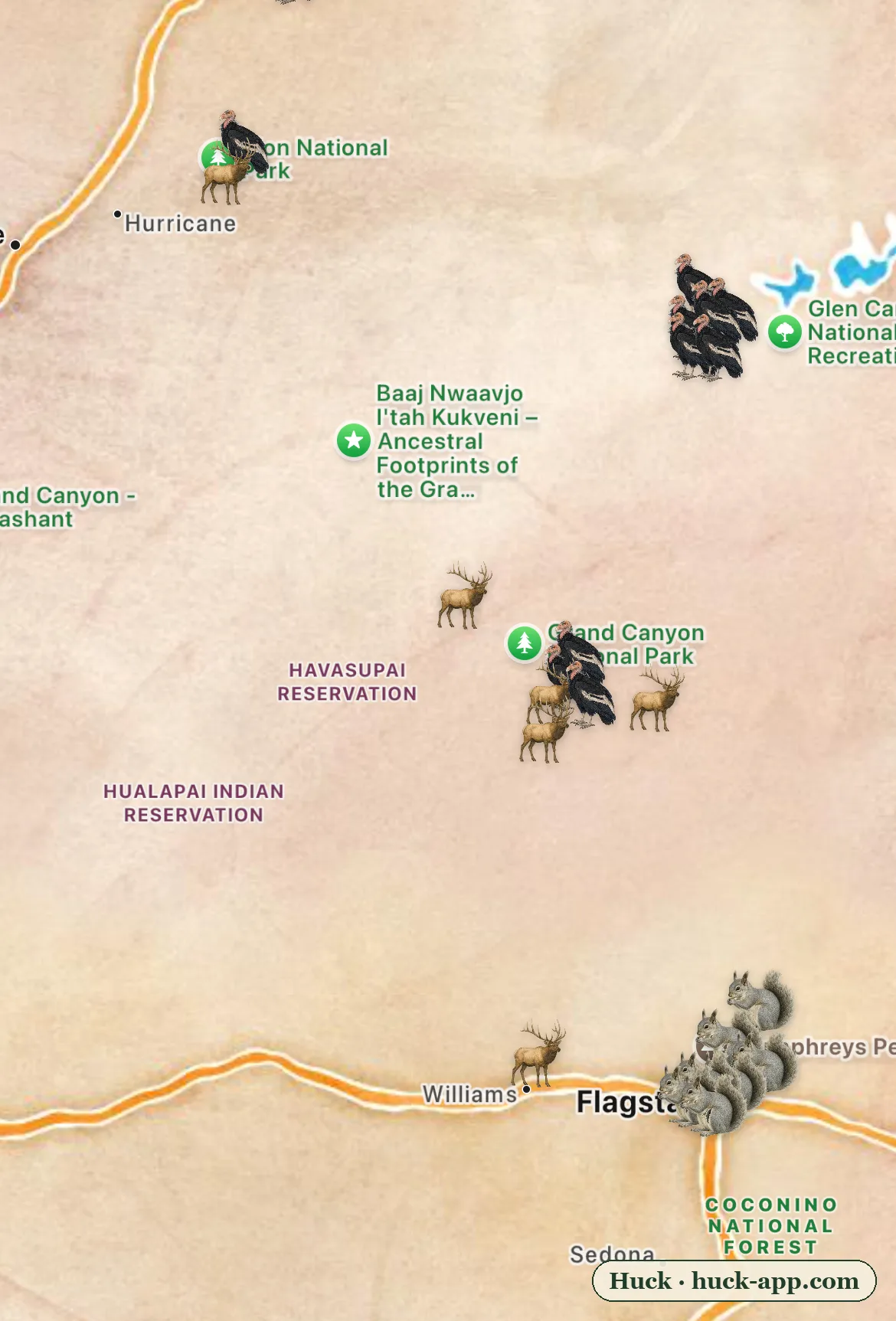
The short answer: the Grand Canyon supports roughly 450 species of birds, about 90 mammals, nearly 60 reptiles and amphibians, and a handful of native fish found nowhere else. The long answer is more interesting, because the canyon is not one habitat but a stack of them: dropping from the rim to the river passes through the same sequence of life zones you would cross driving from Canada to Mexico. The animals sort themselves accordingly, and the map above shows where people actually encounter the headliners.
The one everyone hopes to see: the California condor
The largest flying bird in North America patrols the canyon on a nine-and-a-half-foot wingspan. Every one of them descends from the 22 birds left alive in 1987, and the Arizona-Utah flock, reintroduced starting in 1996 at the Vermilion Cliffs just north of the canyon, now numbers around a hundred. That is why the condor sightings on the map bunch at the top: the release site and Marble Canyon are their home base. In the park itself, your best odds are the South Rim near Bright Angel Trailhead on summer afternoons, when condors ride the thermals rising off the canyon walls. Check the wing tags: every bird is numbered, and rangers know them by name.
The ones you will definitely see: elk and squirrels
The elk grazing the South Rim village lawns are the canyon’s least wild-feeling wildlife and its most dangerous in practice: they are habituated, they are several hundred pounds, and every year visitors get too close. The mule deer are gentler company at dawn and dusk. And the tassel-eared squirrels in the ponderosa pines are worth a longer look than most people give them, because they are two different animals.
The canyon as an evolution experiment: two squirrels
On the South Rim lives the Abert’s squirrel: gray body, white belly, extravagant ear tufts. On the North Rim, separated by ten miles of uncrossable canyon, lives the Kaibab squirrel: charcoal body, striking white tail. They descend from the same ancestor, split when the canyon isolated them, and the Kaibab squirrel now exists nowhere on Earth except the Kaibab Plateau. The canyon did to squirrels what the Galapagos did to finches, and you can see both halves of the experiment in a single day if you drive rim to rim.
The secret locals
The canyon’s best animals work the night shift or the cliff faces. The ringtail, Arizona’s state mammal, is a big-eyed relative of the raccoon that can rotate its hind feet backwards to descend cliffs headfirst; it raids campsites in the dark and is almost never seen doing it. Desert bighorn sheep pick their way along ledges below the rims, most often spotted from the river or on the quieter trails. Mountain lions patrol the rim forests. None of these will appear on a lawn. All of them are down there.
What the sightings map shows
The map in this story plots community observations from iNaturalist: condors clustering at Vermilion Cliffs and Marble Canyon, elk at the South Rim village, and Abert’s squirrels through the ponderosa country around Flagstaff and Williams. Two honest notes: iNaturalist obscures exact coordinates for sensitive species like the condor and bighorn, so those pins are approximate within their general area. And sightings track where the people are, which is why the South Rim looks busier than the vast roadless middle: the animals are in both; the cameras are not.
About the data
Sightings shown are research-grade community observations from iNaturalist, mapped in Huck; counts are as of August 2026. Species totals draw on National Park Service inventories for Grand Canyon National Park. Condor and bighorn coordinates are obscured by iNaturalist for the animals’ protection, so those pins are plotted approximately.