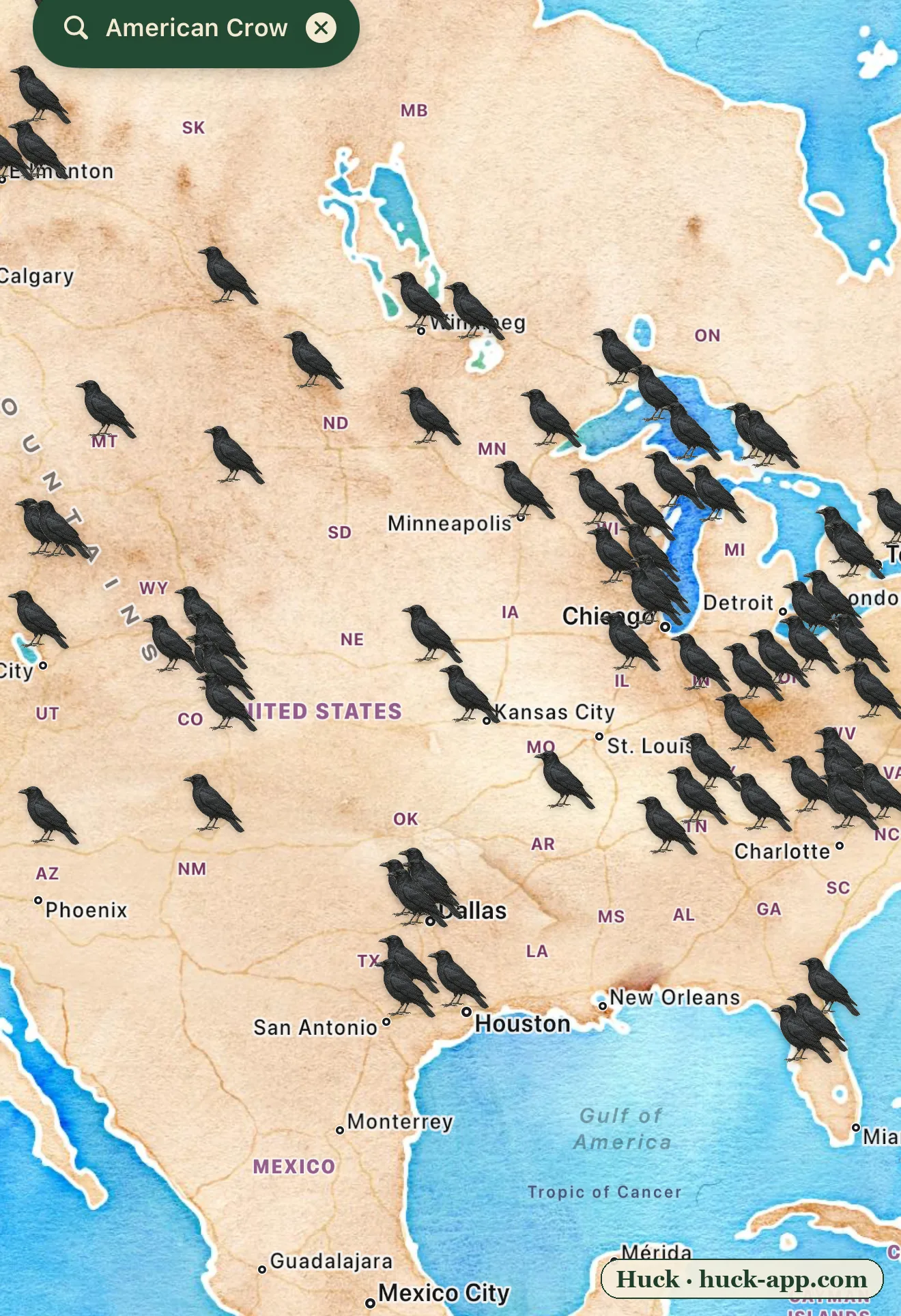
They are both big, black, and unnervingly smart, and people mix them up all the time. But a crow and a raven are genuinely different birds, and once you know the tells you will not confuse them again. It helps that they mostly live in different halves of the country, which the maps make obvious at a glance.
Two birds, two Americas
The American crow, on the map above, is the bird of everywhere, and especially of us. It blankets the country, densest across the East, the Midwest, and every city, suburb, farm field, and parking lot in between. It is the corvid that decided humans were a good thing to live next to, and it followed us everywhere we built.
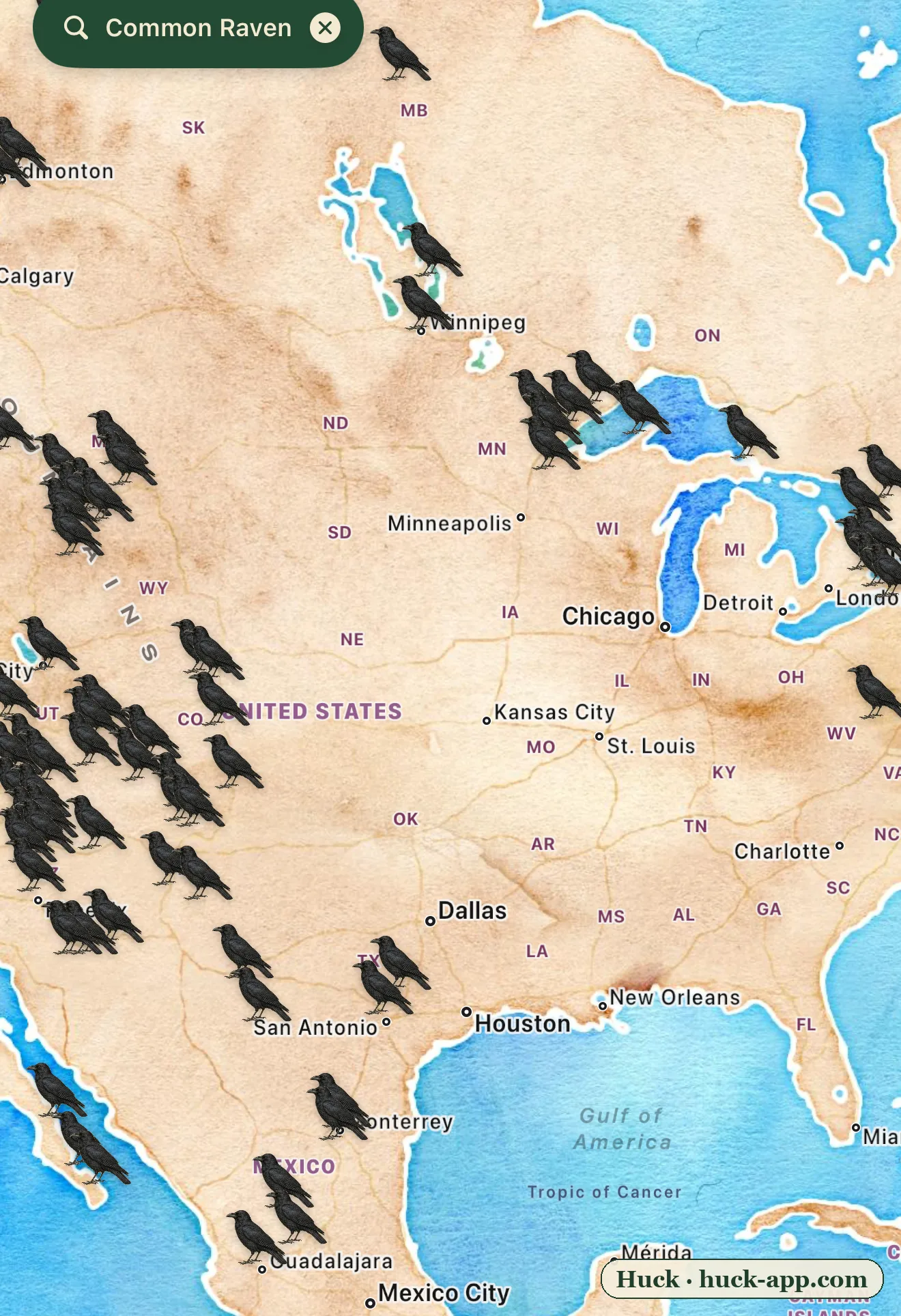
The common raven is the opposite. It is a bird of the wild West and the far North, dense through the Rockies, the Great Basin, the deserts, and up into the boreal forest, and nearly absent from the Great Plains and the Southeastern lowlands. So where you are already tells you which one is more likely overhead. One thing worth watching on the raven map: that thread of records running up the Appalachians. The raven was pushed out of the East by centuries of persecution and clearing, and in recent decades it has been quietly moving back in along the mountains.
How to actually tell them apart
When both could plausibly be over your head, six tells settle it. Size: a raven is much bigger, closer to a hawk than to the pigeon-and-a-half bulk of a crow. Tail: the giveaway in flight, because a crow’s tail opens like a fan with a rounded edge, while a raven’s comes to a wedge or diamond point in the middle. Flight: crows flap steadily, as if rowing, while ravens soar and glide on flat wings and will roll and tumble in the air for no reason but sport. Voice: a crow says a clean, nasal caw, and a raven gives a deep, hollow croak that sounds more like a frog than a bird. Bill and throat: a raven carries a heavier, curved bill and a shaggy beard of throat feathers, where a crow is sleek. Company: crows move in crowds, ravens usually travel in pairs or alone.
Either way, a genius
Whichever one you have, you are looking at one of the smartest animals alive. Corvids make and use tools, solve multi-step puzzles, and plan for the future. They recognize individual human faces, remember the ones who wronged them, and hold the grudge for years, even teaching their neighbors and their young to mob a specific person on sight. Crows gather around their dead in something that looks unsettlingly like a funeral. Ravens have shown the kind of forethought once believed unique to great apes. The bird cawing at you from the wire is not just watching. It is very likely learning you.
What the community data shows
These maps are built from research-grade community observations on iNaturalist: about 150,000 American crow records and 85,000 common raven records, both largely with open coordinates, on the same map frame so you can compare them directly. Sightings track where people are too, but the split is real and old: one bird for the human-built East and the cities, one for the wild West and the mountains, meeting along the edges where the raven is now pressing back.
About the data
Sightings shown are research-grade community observations from iNaturalist, mapped in Huck; counts are current as of September 2026. Coordinates are largely open for both species. The raven’s eastern range recovery and the corvid-intelligence findings, including facial recognition and grudge-holding, draw on published ornithological and cognition research, notably long-term work on corvid behavior.