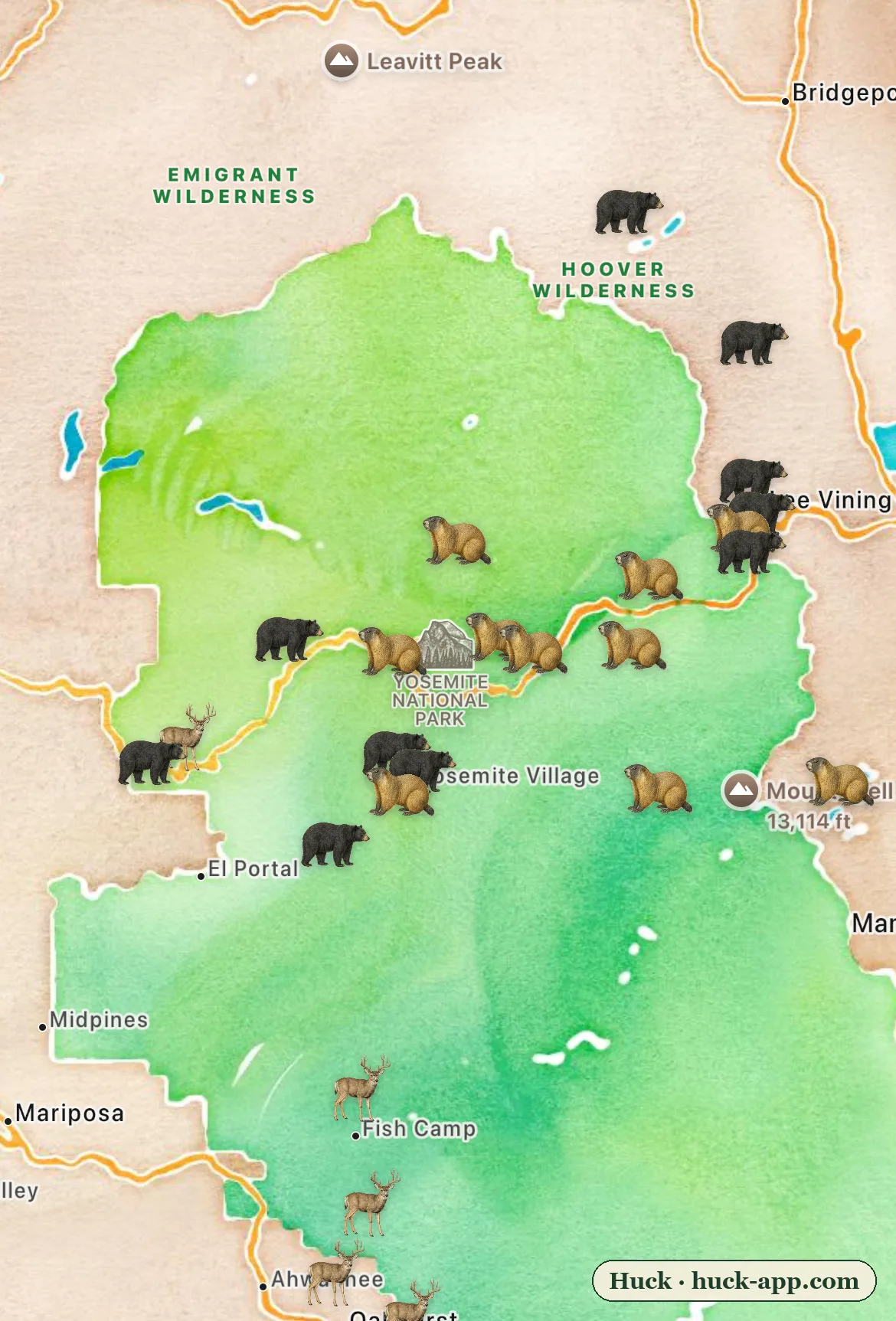
The short answer: Yosemite supports roughly 400 vertebrate species, and the ones visitors ask about first are the black bears - somewhere between 300 and 500 of them live in the park. The ones visitors should also know about: mule deer everywhere, bobcats and coyotes working the valley meadows, yellow-bellied marmots and pikas in the high country, an endangered bighorn sheep staging a comeback on the crest, and the southernmost breeding great gray owls in North America hiding in the meadow forests. The map above shows where people actually record them.
The bears (and the grizzly that is not here)
Every bear in Yosemite is a black bear, even the brown and cinnamon ones - California’s last wild grizzly was killed in the 1920s, which gives the state the distinction of flying an extinct animal on its flag. The living bears are one of the park service’s quietest success stories: after a food-storage overhaul in the late 1990s (bear canisters, food lockers, and a lot of stern signage), human-bear incidents fell by more than ninety percent. The bears went back to eating acorns instead of coolers. On the map, note how many records line the Tioga Road corridor: bears are commonly seen from that road in meadows at dawn.
The high country: marmots and pikas
Above 9,000 feet the granite belongs to the yellow-bellied marmot, a boulder-dwelling groundhog cousin that spends its summer sunbathing and whistling alarm calls, and the pika, a small round relative of rabbits that farms hay piles under the talus all summer because it does not hibernate and cannot afford a bad winter. Tuolumne Meadows and the Tioga Pass pullouts are the reliable spots for both. Pikas are also one of the animals biologists watch closely as the climate warms, because they live at the mountain’s ceiling with nowhere higher to go.
The comeback: Sierra Nevada bighorn
Yosemite’s rarest large mammal is the Sierra Nevada bighorn sheep, a federally endangered subspecies that dwindled to about a hundred animals in the 1990s. Reintroductions brought them back to the Cathedral Range inside the park in 2015 after a century’s absence, and the statewide population has climbed into the hundreds. Seeing one requires real effort and luck on the high crest, which is exactly why the few who do never forget it.
The ghost: the great gray owl
North America’s tallest owl reaches the southern edge of its entire continental range in Yosemite’s mid-elevation meadows. The Sierra population is tiny - a few hundred birds, genetically distinct after ten thousand years of isolation - and the park is its stronghold. Sightings are rare, records are deliberately vague to protect nest sites, and that is how it should be. If you see a very tall, very calm owl watching a meadow edge at dusk, you have won a lottery most birders play for years.
The valley regulars
The mule deer grazing Cook’s Meadow at golden hour are the park’s most photographed animals, and rangers like to point out that deer, not bears, injure more Yosemite visitors - because people walk up to them. Coyotes hunt the same meadows in broad daylight and pose for traffic. Bobcats slip along the valley’s forest edges more often than most visitors realize, usually at dawn, usually gone in three seconds.
About the data
Sightings shown are research-grade community observations from iNaturalist, mapped in Huck; counts are as of August 2026. Species figures draw on National Park Service inventories and the park’s bear management program reporting. Great gray owl records carry obscured coordinates to protect nesting sites, so the map omits them; sightings for the mapped species (black bear, mule deer, yellow-bellied marmot) are openly located.