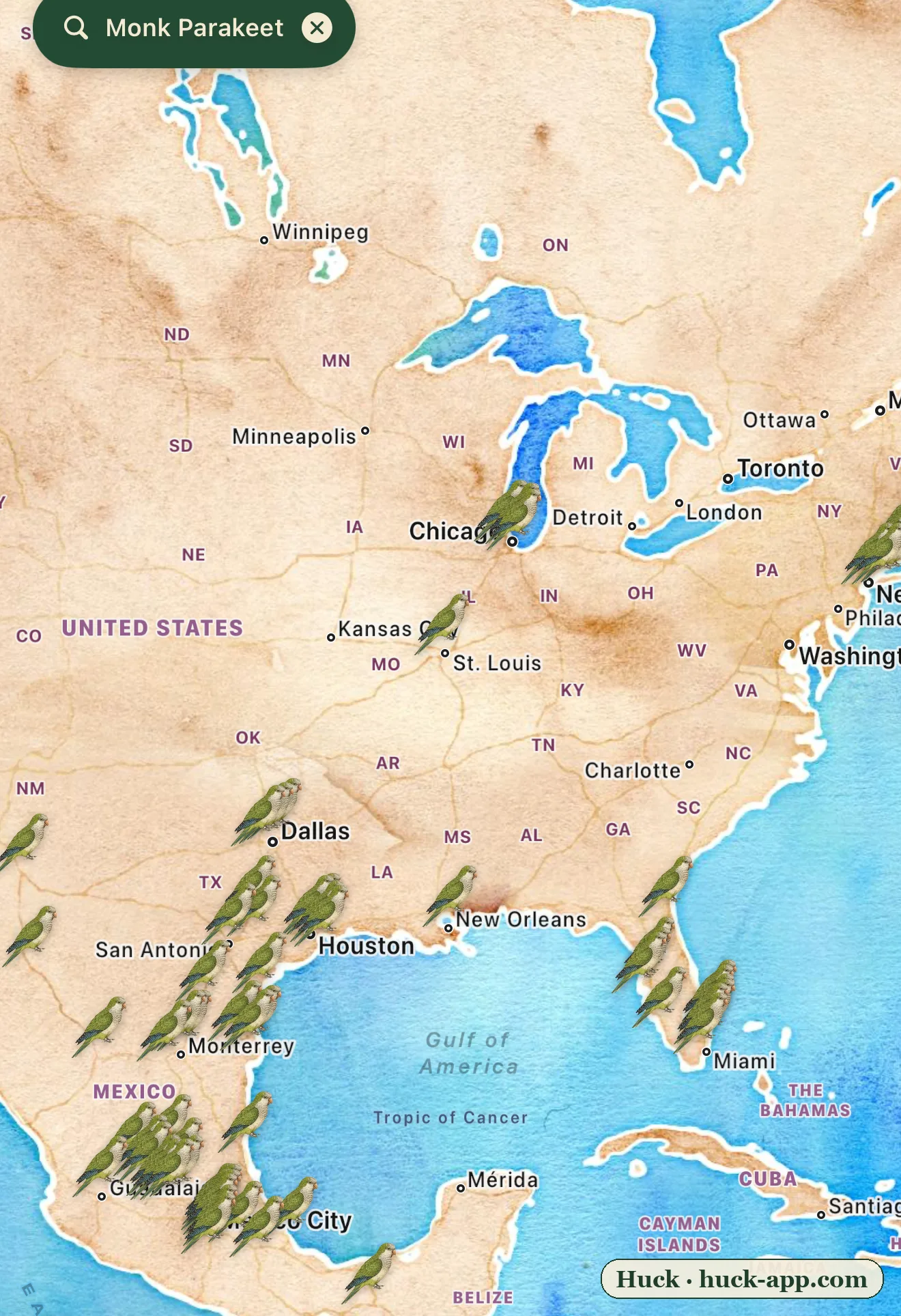
There are wild parrot flocks screeching over American cities, and not only in the warm ones. None of them flew here on their own. They are the descendants of escaped and released pets that found the climate and the food good enough to stay, and a couple of species have quietly turned the United States into real parrot country. The map shows where they set up shop, and the surprising part is how far north it goes.
The parakeet that beat winter
The most successful is the monk parakeet, a small green-and-gray parrot that most people would bet could never survive a northern winter. It can, and the reason is in its passport: it comes from temperate South America, the grasslands of Argentina and Uruguay, not the tropics, so it evolved alongside real cold. That is why the map shows it not just in Miami and Houston but holding permanent colonies in Chicago and Brooklyn, riding out lake-effect snow while its tropical cousins would freeze.
It has another trick no other parrot shares. Every other parrot nests in a hole in a tree; the monk parakeet builds a nest out of sticks, and not a small one. Whole flocks construct sprawling communal stick fortresses the size of a small car, with separate chambers for each pair, and they love to anchor them on utility poles and electrical substations, where the warmth is a bonus and the power company is not amused. Their feud with the electric utilities is a running subplot of the American monk parakeet story.
The parrot that is safer in exile
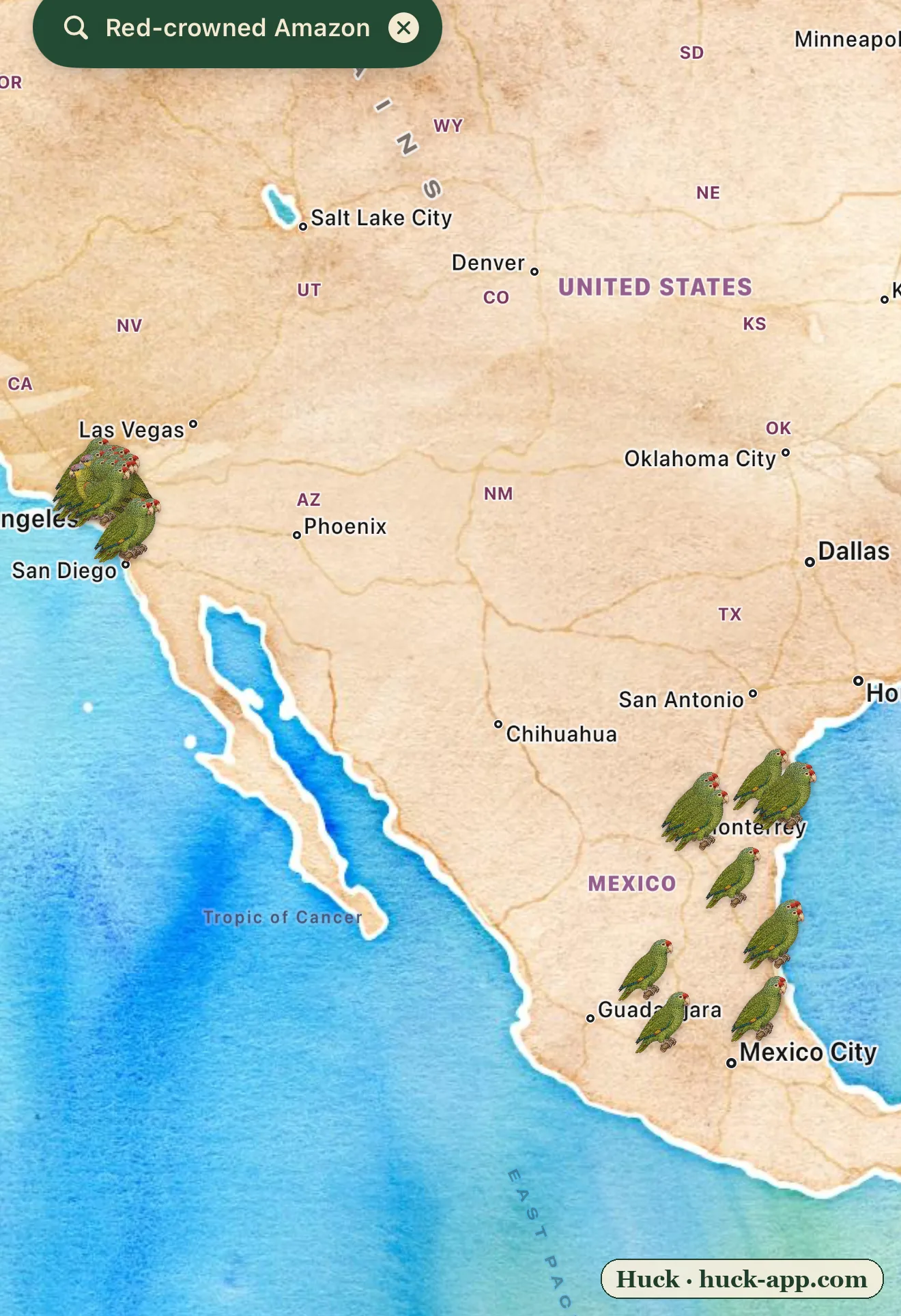
Then there is the strange one. The red-crowned parrot is endangered in its native range, a shrinking pocket of northeastern Mexico, hammered by habitat loss and decades of trapping for the pet trade. But a feral population, built entirely from escaped and released pets, now thrives in Southern California and South Texas. By some counts there may be nearly as many red-crowned parrots living wild in the United States as remain in the wild in Mexico. It is a bird that may be safer in exile than at home, an accidental ark assembled out of the same pet trade that emptied its forests.
How the flocks got started
The wave began with the mid-twentieth-century boom in imported pet birds. Some escaped one or two at a time from homes and aviaries; others got loose in bulk, and monk parakeet lore points to a shipment that reportedly broke open at New York’s JFK airport in the late 1960s. Wherever the winters were survivable and the food was steady, ornamental fruit, palm nuts, and backyard seed feeders, small escapes grew into flocks, and flocks became self-sustaining. Today the established colonies breed on their own, no pet store required.
Pest, treasure, or lifeboat
What to make of them is genuinely unsettled. Utilities battle monk parakeet nests on their equipment, and in the birds’ native range they can be serious crop pests. But city by city, the flocks have become beloved local characters; the wild parrots of San Francisco’s Telegraph Hill got their own documentary. And the red-crowned parrot scrambles the usual instinct that introduced always means bad, because an accidental American population may turn out to be a genetic lifeboat for a species disappearing at home. The parrots overhead are a small, loud test of how we decide what belongs.
What the community data shows
These maps are built from research-grade community observations on iNaturalist: roughly 9,500 monk parakeet records and 8,000 red-crowned parrot records, largely with open coordinates. Parrots are loud, colorful, and city-dwelling, so they get photographed heavily where birders live, but these are not one-off escapees on the map. They are established, breeding, multi-generation flocks, and their footprint is still spreading.
About the data
Sightings shown are research-grade community observations from iNaturalist, mapped in Huck; counts are current as of September 2026, and coordinates are largely open for both species. The monk parakeet’s temperate origin and cold tolerance, and the red-crowned parrot’s endangered status alongside its feral US range, draw on published ornithological sources and IUCN assessments.
