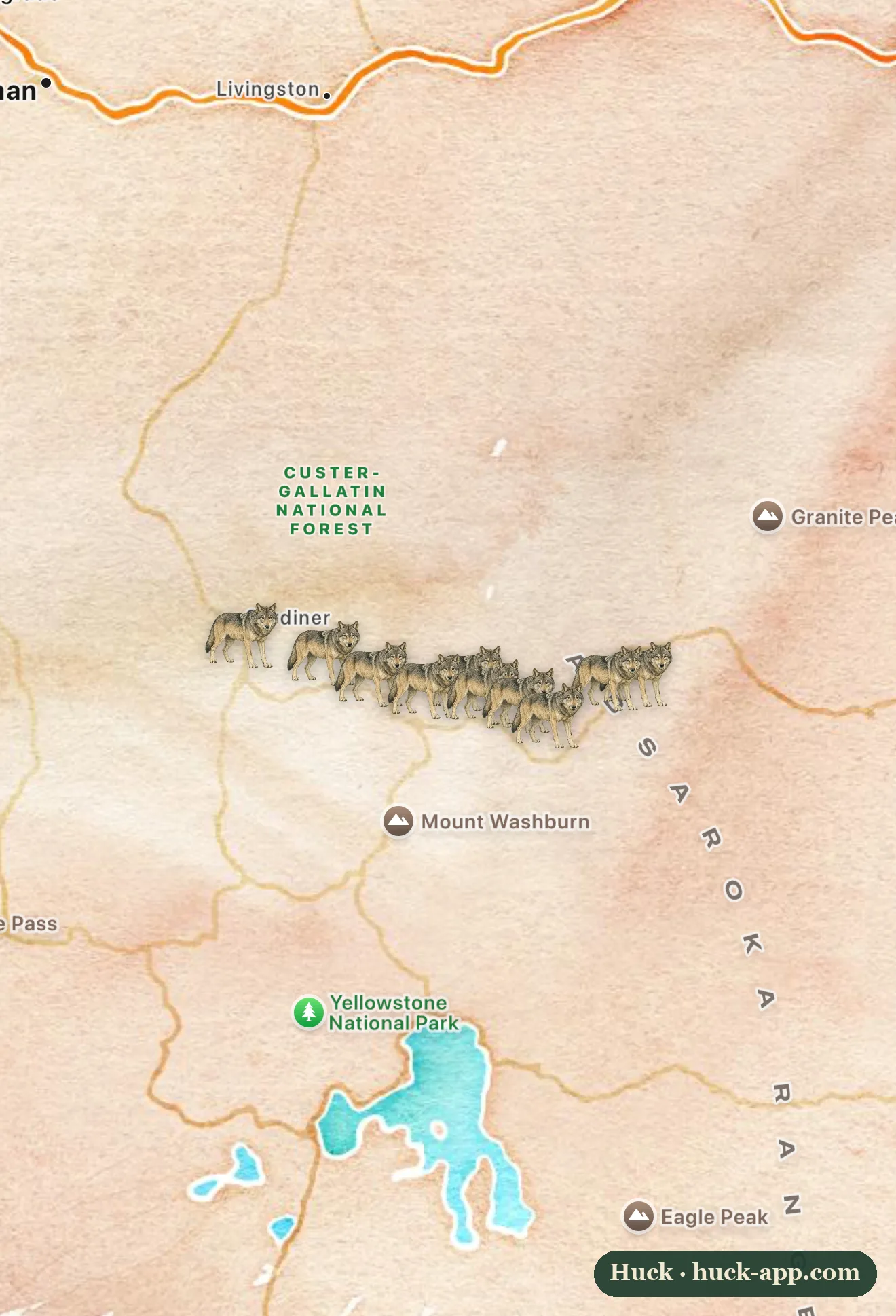
If you want to see a wild wolf in the lower 48, there is one place that beats the rest, and one season. Yellowstone’s northern range in winter is wide-open valley country, the snow turns every dark animal into something you can pick out from a mile away, and the elk the wolves hunt are crowded onto their winter ground. The map shows the stretch of the park where the wolf watchers gather, along the one road that stays open all winter.
The road that stays open
Most of Yellowstone’s roads close to cars in winter. The exception is the northern road from the North Entrance at Gardiner, past Mammoth Hot Springs, across the Blacktail Plateau, through the Lamar Valley, and out to the little town of Cooke City. That road happens to run through the heart of wolf country, so the whole winter operation of wolf watching happens along it: pullouts, spotting scopes, and people who have stood in the cold at dawn for twenty years.
Where to look
The Lamar Valley is the headline, a broad river valley often compared to the Serengeti, with bison, elk, and the packs that hunt them in view at once. Slough Creek and the Little America flats just west of it are the other classic watching grounds, and the Junction Butte area between them has been home to some of the most watched packs in the park. Farther west, the Blacktail Plateau and the country toward Mammoth can produce wolves too. The trick is the same everywhere: drive slowly, look for a row of parked cars and tripods, and pull over quietly. The watchers usually know where the packs are and are often glad to let you look.
When to go
December through March is prime time, with February bringing the breeding season, when packs are restless and travel widely. Be in position at first light, because wolves are most active around dawn and dusk. Bring a spotting scope or the best binoculars you can borrow, since most sightings are at a long distance, and dress for subzero mornings. A clear, cold day after fresh snow is the best possible setup.
Gone, then back
Wolves were deliberately wiped out of Yellowstone by the 1920s, as they were from nearly all of the West. For seventy years the park had none. Then in 1995 and 1996, biologists trucked in wolves captured in Canada and released them, and a few more followed from Montana. The packs took off, and the park has generally held somewhere around a hundred wolves since, spread across roughly ten packs. How much their return changed the rest of the ecosystem, the elk, the streamside willows, the beavers, is still argued over by ecologists. That they changed the experience of visiting Yellowstone in winter is not.
About the map and the data
Wolf sightings on community platforms are partly obscured to protect den sites, and plotting them would scatter the picture. So the markers here sit at established, public wolf-watching areas along the open northern road, the places the National Park Service and the watching community point visitors to. Pack and population figures draw on the Yellowstone Wolf Project’s annual reporting. Stay at least 100 yards from wolves, never follow or call to them, and keep to the road and pullouts.