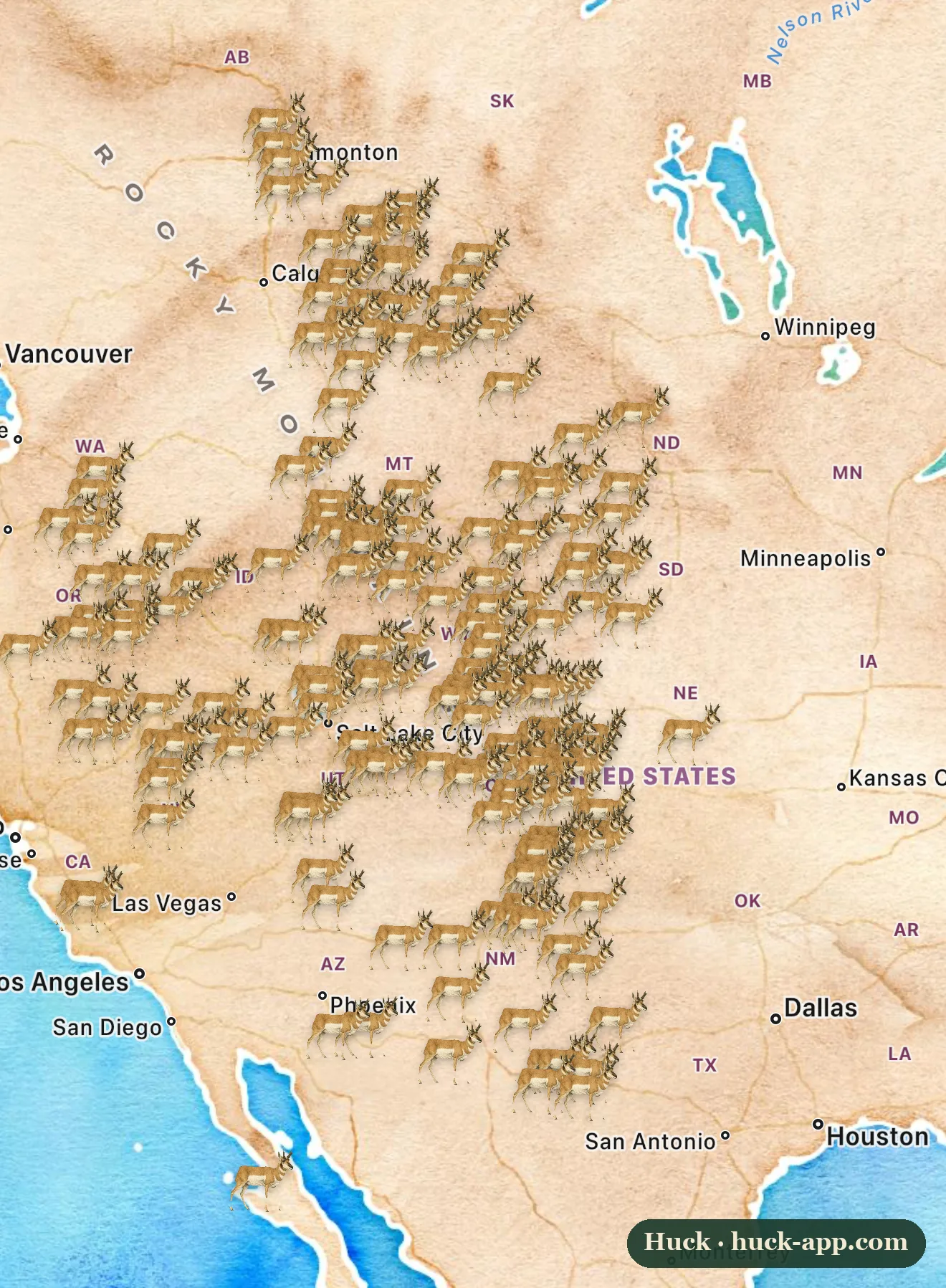
There is an animal out on the open West that is faster than it has any reason to be. The pronghorn can hit fifty-five miles an hour and, more impressively, hold a blistering pace for miles without slowing, which makes it the fastest land animal in the Americas and the best distance runner of any big animal on Earth. Nothing alive on this continent can come close to catching it. The map shows where it still ranges, a solid wash of animals across the sagebrush and shortgrass with a clean edge where the Great Plains give way to farm country. The strange part is why it runs the way it does.
Built to outrun a ghost
The pronghorn is wildly overbuilt for any predator it will ever meet. A coyote or a wolf tops out far below its cruising speed, so all that horsepower looks like a waste. The answer is that the pronghorn is not running from anything that exists now. For most of the last few million years, North America had its own cheetah, a fast cat biologists call the American cheetah, and the pronghorn and that cat ran an arms race across the open country for ages. The cat went extinct around twelve thousand years ago, at the end of the Ice Age, along with most of the continent’s big mammals. The pronghorn never got the memo. It still carries the speed it needed to beat a predator that has been gone since before farming was invented, which is why watching one run flat out across a Wyoming basin is, in a real sense, watching a race with a ghost.
Not an antelope at all
Almost everyone calls it an antelope, and it is not one. The pronghorn is the sole survivor of an entirely American family, Antilocapridae, that once included a dozen or more species, some with wild corkscrew and four-pronged horns. Its nearest living relatives are not the antelope of Africa at all but the giraffe and the okapi. It also wears a piece of equipment no other animal has: its horns are branched, with a forward-pointing prong, and it sheds the black outer sheath of each horn every year and grows a new one over the permanent bony core. No other animal on Earth both branches its horns and sheds them like that.
Eyes like a pair of binoculars
Speed is only half of the pronghorn’s survival kit; the other half is sight. Its eyes are enormous for its skull, set high and wide on the head, and they give it a field of view of nearly three hundred and twenty degrees and the ability to pick out movement miles away across open ground. On a treeless plain there is nowhere for a predator to hide, so the pronghorn simply sees trouble coming from a great distance and is gone before it arrives. Eyes and legs, working together, are the whole plan.
The animal that runs but will not jump
For all that speed, the pronghorn has one glaring blind spot: it almost never jumps. Where a deer will sail over a fence without breaking stride, a pronghorn goes under it, and a single strand of barbed wire strung low can stop an animal that just outran everything on the continent. That quirk collides with the pronghorn’s other great feat, migration. Some herds make one of the longest overland journeys left in the Lower 48, including the famous Path of the Pronghorn, a roughly hundred-and-fifty-mile route in Wyoming that the animals have walked for about six thousand years, funneling through narrow bottlenecks between summer and winter range. Fences, roads, and subdivisions sit squarely across those routes, and in brutal winters pronghorn have died in the hundreds piled against a fence line they could not cross. The fix is almost absurdly simple, raising the bottom wire and smoothing it so the animals can scoot under, and ranchers and biologists across the West have been swapping in this wildlife-friendly fencing mile by mile.
From thirteen thousand back to the plains
This is also a comeback. Tens of millions of pronghorn once covered the West alongside the bison, and the same century of market hunting and fencing that nearly erased the bison knocked the pronghorn down to perhaps thirteen thousand animals by the 1920s. Careful management and hunting limits brought them back to somewhere around half a million to a million today. Wyoming holds the biggest share by far, enough that the state is often said to have more pronghorn than people. The clusters glowing thickest on the map, across Wyoming and Montana and the high basins, are that recovery, still leaning on the open, connected country the animal needs to move.
Where and when to see one
Pronghorn are animals of wide-open sagebrush and shortgrass, so you find them by scanning distance, not by walking into cover. The surest country is Wyoming, around Grand Teton, the Green River Basin near Pinedale, and the plains near Lander and Casper; the National Bison Range and central Montana; the badlands of the Dakotas, including Theodore Roosevelt National Park; and the Great Basin sage of eastern Oregon, Nevada, and New Mexico. Fall is a good time to look, when the herds bunch up and begin shifting toward winter range along those ancient corridors. Bring binoculars, expect them to spot you first, and give migrating animals room.
What the community data shows
This map is built from roughly twenty-five thousand research-grade pronghorn observations on iNaturalist, the large majority with open coordinates. Community sightings always lean toward where people travel, but the overall shape is exactly what you would expect from the biology: a dense core across the Intermountain West and the high plains, a hard eastern edge where the shortgrass runs out, and thinner strands reaching north into the Canadian prairies and south into the Mexican deserts.
About the data
Sightings shown are research-grade community observations from iNaturalist, mapped in Huck; counts are current as of October 2026. A small fraction of pronghorn records carry obscured coordinates, so a few pins are approximate, but the range and the concentrations are unaffected. The speed figures, the American cheetah hypothesis, the Path of the Pronghorn and fencing issues, and the population history draw on published wildlife research and state agency reporting.