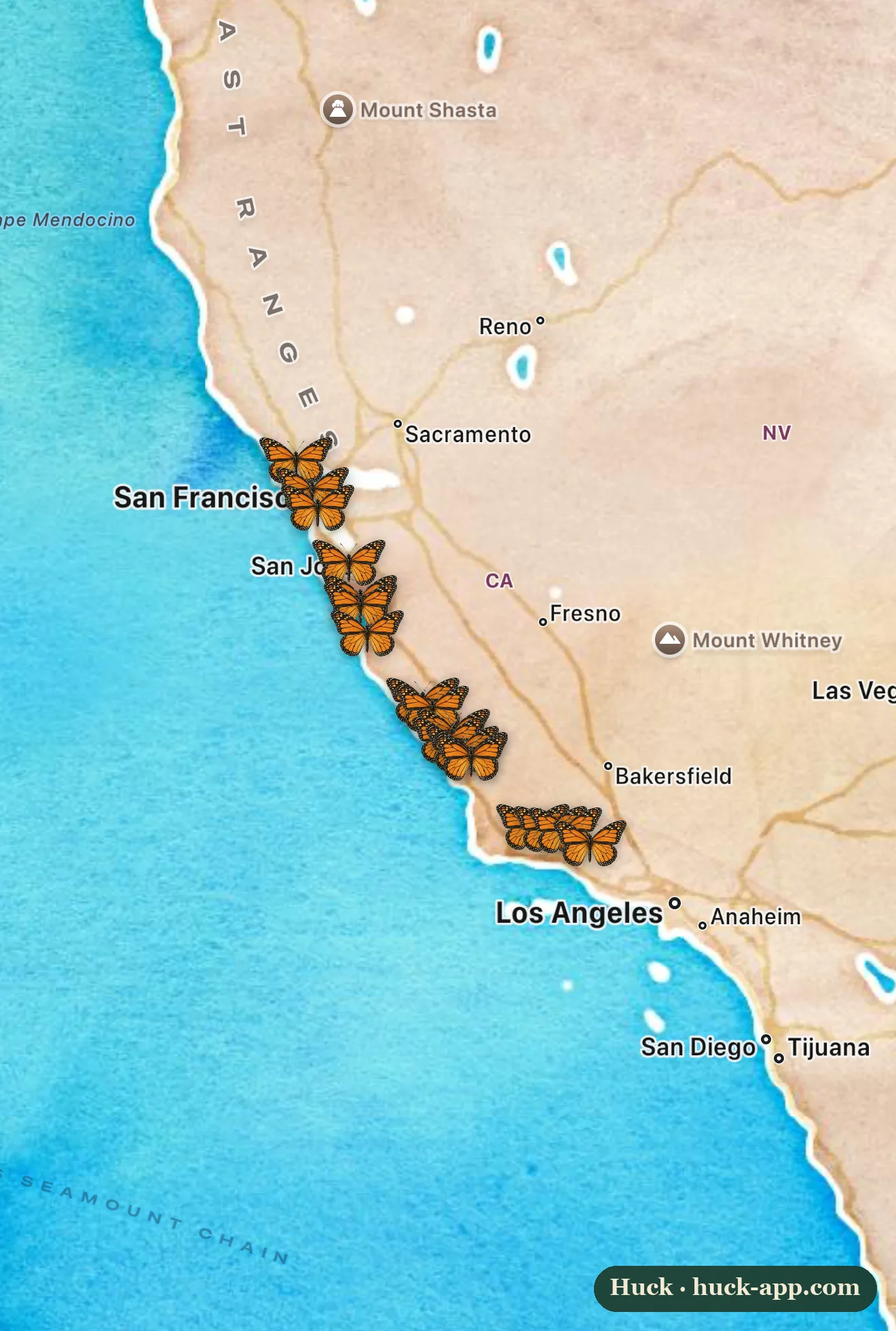
Right now, up and down the California coast, monarch butterflies are coming in to land for the winter. Not the ones you may have read about heading for the mountains of central Mexico; those are the eastern monarchs. The butterflies arriving on the California coast this month are the western population, and instead of crossing a border they settle into a short string of coastal groves and hang there by the thousands until spring. The map above shows where the famous ones are, and the season is just getting started.
What you actually see
An overwintering grove does not look like much at first. The monarchs cluster on the branches of a few favored trees with their wings closed, and a cluster of closed monarchs looks almost exactly like a clump of dry leaves, which is the point. Then the sun comes around and warms them, and the whole mass loosens and lifts, and suddenly a tree you walked past is breathing orange. On a mild afternoon they fan out to drink and then stream back to the same branches at dusk. Thousands of butterflies packed onto a single bough is one of the strangest and most delicate things you can see in the American outdoors.
Where to go
A handful of public groves do most of the work, and they are easy to visit. The Pismo State Beach Monarch Butterfly Grove, right off Highway 1 on the central coast, is usually the largest and most reliable, with volunteer docents and spotting scopes set up through the season. Pacific Grove, on the Monterey Peninsula, has called itself Butterfly Town USA for a century and protects its Monarch Grove Sanctuary. Natural Bridges State Beach in Santa Cruz holds a classic eucalyptus grove with a boardwalk right into it. Farther south, the Ellwood Mesa and Coronado Butterfly Preserve in Goleta, just west of Santa Barbara, is the big southern site. Morro Bay, Big Sur, and a scatter of smaller groves fill in the coast between them.
When to go
The window is roughly November through February, and the butterflies are usually at their peak from about Thanksgiving through mid-January. Go on a calm, sunny late morning or afternoon, when the clusters open and fly; a cold, windy, or gray day keeps them shut tight and still. The annual Western Monarch Thanksgiving Count, run by thousands of volunteers around late November, is both the best moment to see them and the way the population gets measured each year.
Why California instead of Mexico
The split comes down to a mountain range. Monarchs that spend the summer east of the Rocky Mountains funnel south to a few oyamel fir forests in central Mexico, the migration most people know. Monarchs west of the Rockies take a much shorter trip to the California coast, where the ocean keeps winter mild: no hard freezes to kill them, no heat to burn through their fat reserves, and coastal fog to keep them from drying out. The groves they choose, often eucalyptus, Monterey pine, and Monterey cypress, give them just enough shelter and just enough sun. We mapped the eastern journey separately; this is the western half of the same animal, wintering closer to home.
See it while you still can
This is not a spectacle to put off. The western monarch population has fallen more than 95 percent since the 1980s, when millions wintered on the coast. In the winter of 2020 the count came back under 2,000 butterflies total, a drop so steep that biologists openly discussed the migration blinking out. It bounced back to the low hundreds of thousands for a couple of years, then crashed again to around 9,000 in the 2024 count, one of the lowest ever recorded. The number swings wildly from year to year, but the long line points steadily down, which means some of these groves hold a fraction of what they did a generation ago, and a few historic sites now sit empty.
How to visit without hurting them
A clustered monarch is running on a tight winter fuel budget, and every time one is startled into the air it burns energy it cannot spare. Stay on the trails and boardwalks, keep your voice down, and never shake a branch or handle a butterfly to make the cluster fly. If you want to help beyond the visit, plant native nectar flowers, and plant milkweed only well inland, not within a few miles of the coast, where out-of-season milkweed can actually disrupt the overwintering cycle. And log what you see: community counts are a real part of how this population is tracked and fought for.
About the map and the data
Unlike most of our maps, this one is not built from raw community pins. Overwintering monarchs gather at specific, well-documented groves, and a share of monarch records carry obscured coordinates, so plotting every sighting would scatter the picture rather than sharpen it. Instead the markers are placed by hand at known public overwintering sites along the California coast, the same places the Xerces Society and its volunteers monitor each winter. Grove locations and viewing seasons draw on Xerces Society and California State Parks guidance; the population figures come from the Western Monarch Thanksgiving Count.