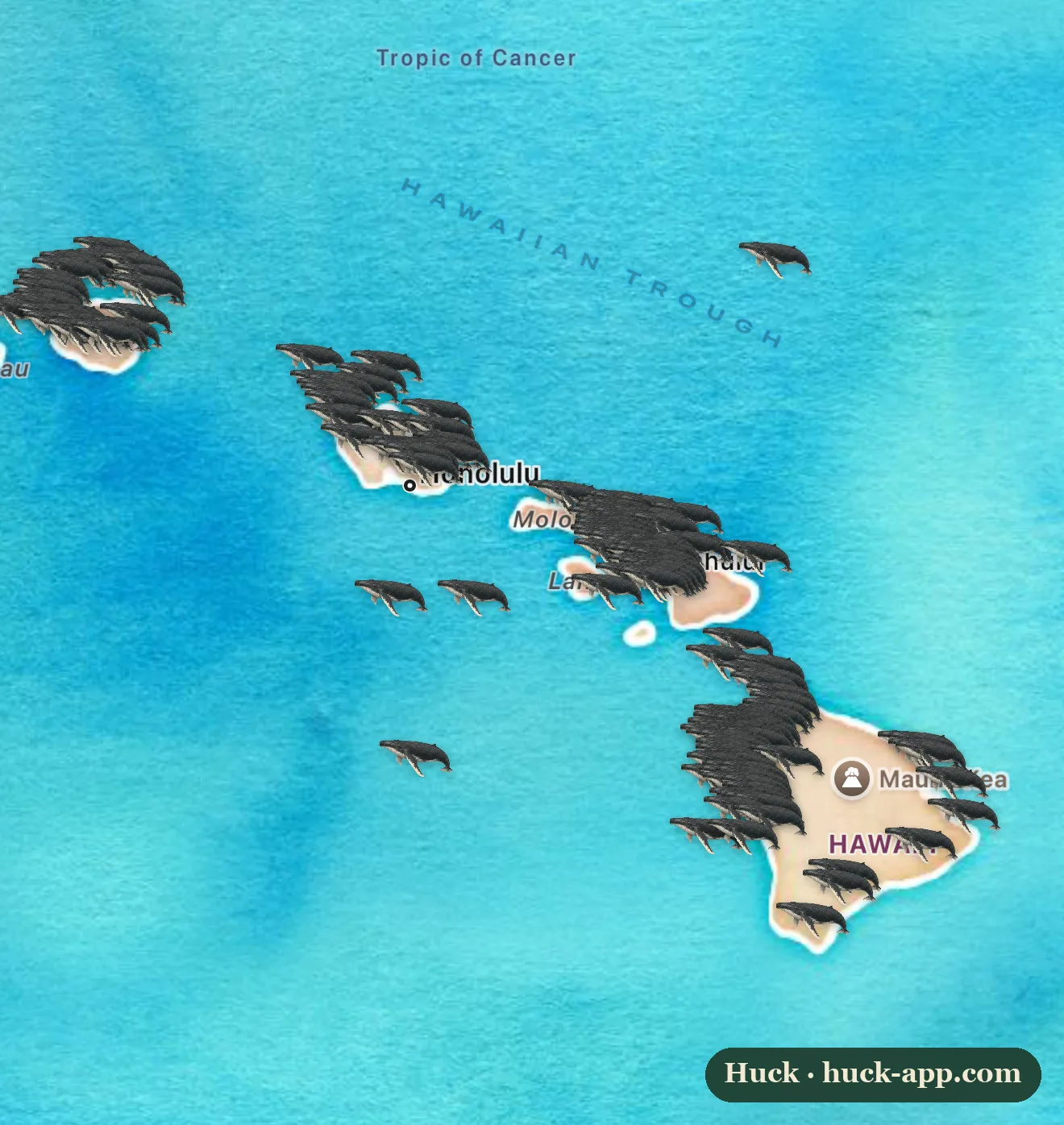
Every winter, humpback whales leave the cold feeding grounds of Alaska and swim roughly three thousand miles to the warm, shallow water around Hawaii. They come to breed and to give birth, and for a few months the islands are full of them: breaching, slapping the water with tails and fins, and singing. The first arrivals are showing up now. The map shows where they gather, and the densest cluster is no accident.
Why off Maui
The channel between west Maui, Lanai, Molokai, and Kahoolawe is shallow, warm, and sheltered, the closest thing in the islands to a protected nursery. Mothers with newborn calves stay in that calm water, and males follow the females, which is why the channel holds the biggest concentration of humpbacks in Hawaii and one of the biggest anywhere. It is protected as part of the Hawaiian Islands Humpback Whale National Marine Sanctuary.
Where to watch from land
You do not need a boat. On Maui, the Papawai Point and McGregor Point lookouts along the highway between Maalaea and Lahaina sit high over the channel, and the beaches of Kihei and Wailea look straight out at it. On the Big Island, the Kohala coast north of Kona is excellent. Kilauea Point on Kauai’s north shore and the Makapuu Point lighthouse trail on Oahu are reliable too. Scan for the spout, a column of mist that hangs over the water, then keep watching the same spot. Boat tours run out of Maalaea and other harbors if you want to get closer, and federal rules keep vessels at least 100 yards away.
When to go
The season runs roughly from November into April, and the peak is January through March, when the most whales are in the islands at once. Calm mornings make spouts and breaches easiest to see. The sanctuary runs a volunteer whale count from shore on a Saturday in late January, February, and March, which is a fun way to spend a morning and contributes to the science.
Months without eating, and a song that changes
The humpbacks in Hawaii are mostly fasting. They do their eating in Alaska and live off their fat in the islands, which is why mothers, nursing calves that gain weight fast on rich milk, come out of the season so thin. The males sing, long, complex songs that carry for miles underwater, and all the males in the population sing a version of the same song, which slowly shifts from one year to the next. If you snorkel or swim in the channel in winter, you can sometimes hear it.
A recovery with a recent dip
Commercial whaling drove North Pacific humpbacks down to a small fraction of their former numbers, and their recovery after protection is one of the great conservation turnarounds. The Hawaii population grew so strongly that it was removed from the endangered list in 2016. More recently, researchers have recorded fewer whales than at the peak a decade ago, a drop tied to the marine heat wave that disrupted the North Pacific food web. The whales are still here in the thousands, and how the population recovers from that dip is being watched closely.
About the data
This map is built from research-grade humpback whale observations on iNaturalist, with open coordinates, zoomed to the main Hawaiian Islands. Sightings cluster where people watch from boats and shore, which matches where the whales concentrate. Season and population details draw on NOAA Fisheries and the Hawaiian Islands Humpback Whale National Marine Sanctuary.