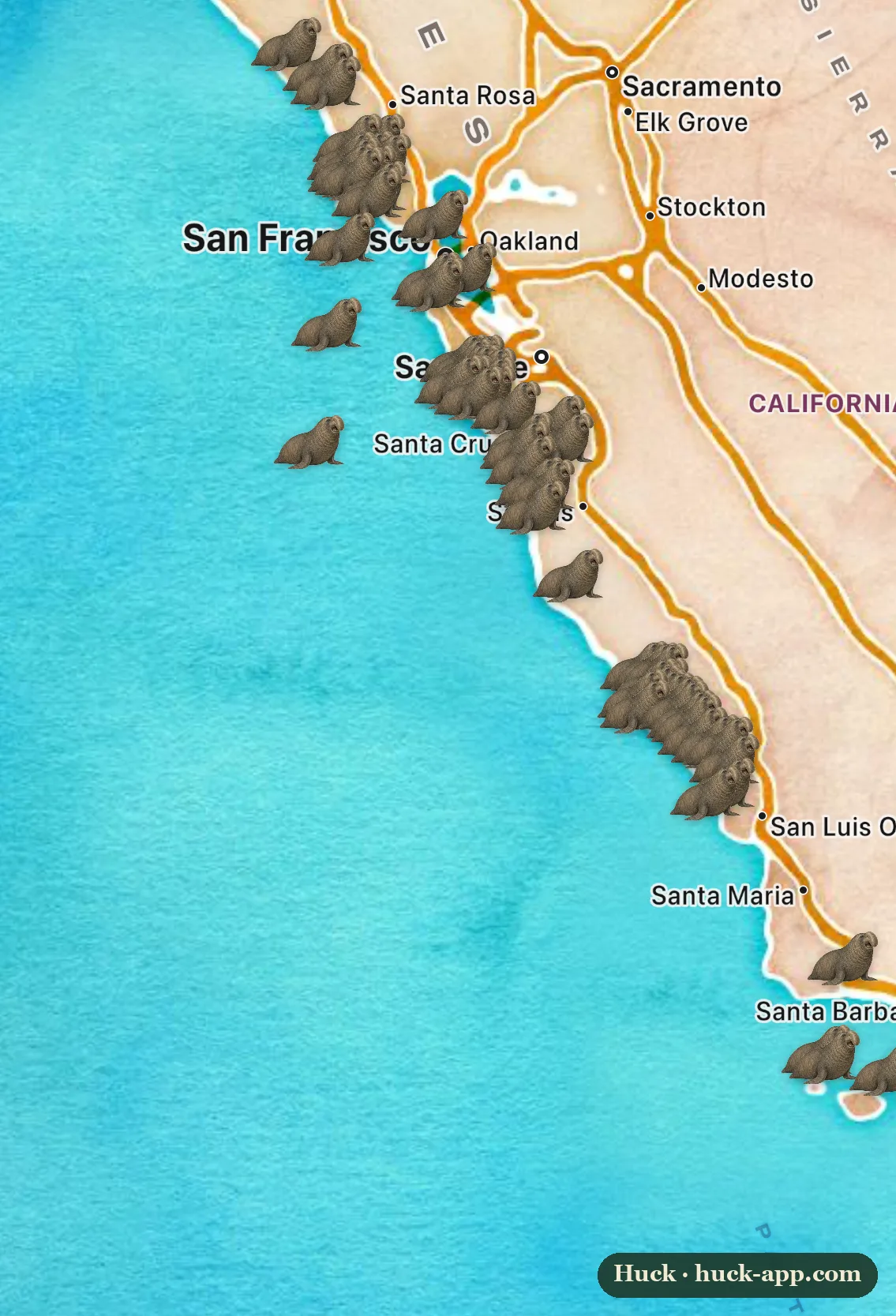
Right about now, the first bull elephant seals are hauling themselves out of the Pacific onto a short list of California beaches. Over the next few weeks they will be joined by thousands of females, nearly all of them pregnant, and the beaches will fill with roaring, shoving, bleeding giants and the pups being born between them. It is one of the wildest wildlife scenes in the country, and some of the best of it is visible from a parking lot off Highway 1. The map shows where the colonies are.
What you are looking at
A full-grown bull northern elephant seal can run around sixteen feet long and something like two and a half tons, with a drooping trunk of a nose he inflates into a resonating chamber to make a sound like a rusty engine being kicked. Bulls arrive first and fight for position on the beach, rearing up chest to chest and slamming their heads and teeth into each other’s necks, which are armored with a thick shield of scarred skin for exactly this. The few dominant bulls end up surrounded by dozens of females. Most bulls never mate at all.
The females come ashore a few weeks later and give birth within days. A pup is born at around 75 pounds and nurses on milk so rich it roughly quadruples its weight in about a month. Then the mother mates, stops nursing, and goes back to sea, and the fat, sleek pups, called weaners, are left on the beach to teach themselves to swim. The whole breeding season happens on land in a little over two months, with the adults barely eating the entire time.
Where to go
The easiest and most dramatic spot is Piedras Blancas, a few miles north of San Simeon and Hearst Castle on Highway 1. The colony sprawls right below a free roadside boardwalk, the overlook is open year round, and volunteer docents from the Friends of the Elephant Seal are often on hand to explain what you are seeing. Farther north, Año Nuevo State Park between Santa Cruz and Half Moon Bay is where the mainland colony began, and in breeding season the beach is reached only on ranger-led walks that need a reservation, so book ahead. Point Reyes National Seashore has its own colony, visible from the Elephant Seal Overlook near Chimney Rock and along Drakes Beach, with weekend shuttles in winter.
When to go
Bulls start arriving in late November and fight hardest through December and January. Births run from late December into early February, and the beaches hold the most animals around late January, when bulls, mothers, and newborn pups are all there at once. By March the adults have left and the weaners have the beach mostly to themselves. Any time from now through February is worth the trip; late January is the peak.
An animal that came back from about twenty
These seals were hunted for their oil so relentlessly in the 1800s that by the 1890s the entire species was thought to be gone, and the survivors, perhaps a few dozen, hung on at a single remote island off Baja California. Protection by Mexico and then the United States let that remnant rebuild, and the population is now well over two hundred thousand. The Piedras Blancas colony did not even exist until the early 1990s, when a few seals started using the beach. Every animal on the map descends from that tiny surviving group, which is why elephant seals have strikingly little genetic diversity.
Watch from a distance
Elephant seals look slow and sleepy, and they can move across sand faster than you would believe, especially a bull in a fight. They are protected under the Marine Mammal Protection Act, so stay on the boardwalks and trails, keep well back on any open beach, and never get between a seal and the water. The animals spend the rest of the year far out at sea, diving close to a mile deep and staying under for well over an hour at a time, so the beach is the one place you will ever see them.
About the data
This map is built from roughly 12,500 research-grade elephant seal observations on iNaturalist, almost all with open coordinates, so the clusters sit right where the colonies are. Population and history figures draw on NOAA Fisheries, California State Parks, and the Friends of the Elephant Seal.