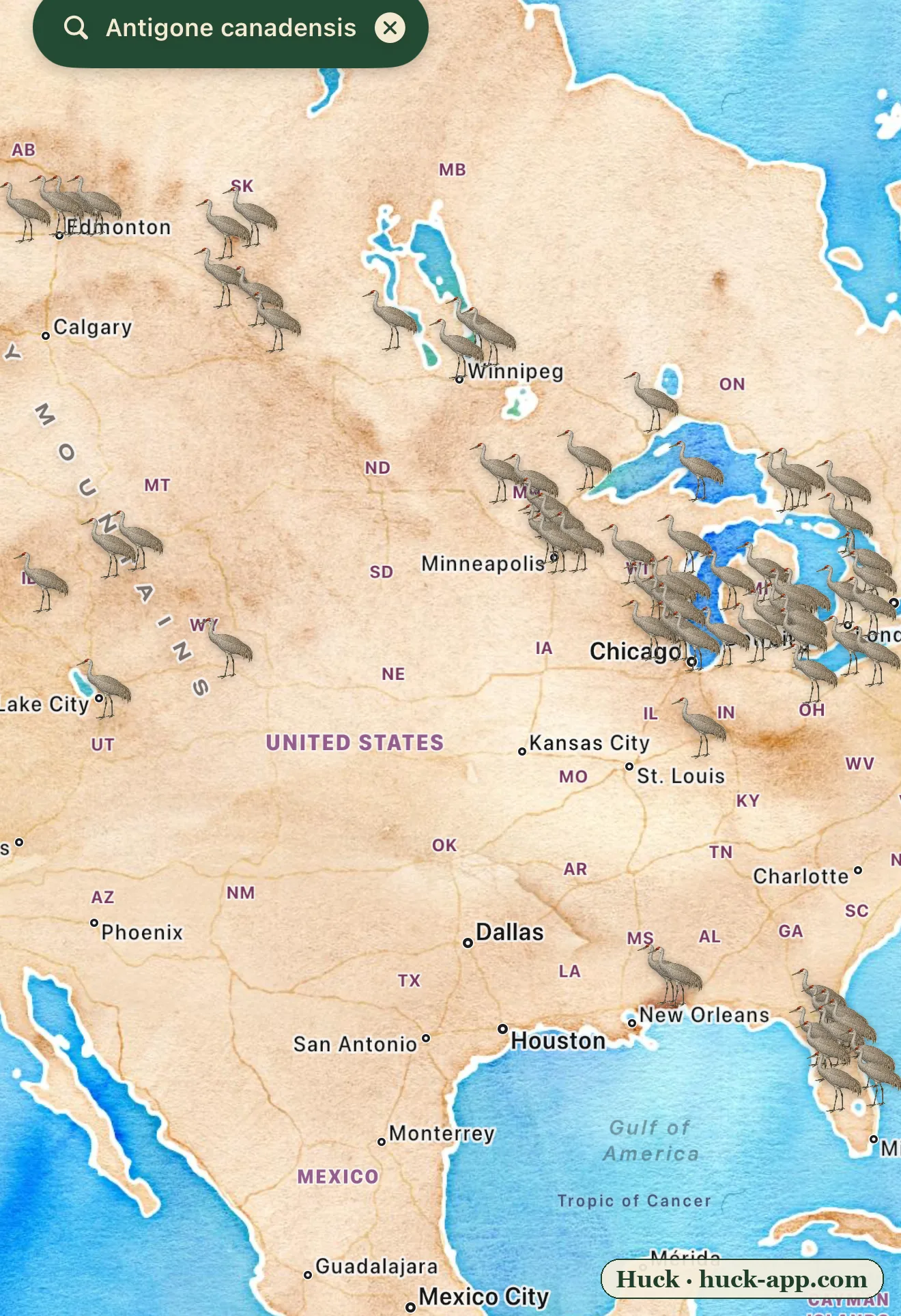
Right now, across the middle of the continent, one of the oldest migrations on Earth is in motion. Sandhill cranes, four-foot-tall gray birds with a rolling bugle you hear long before you see them, are moving south along flyways their ancestors have used for an unimaginably long time. The map shows where they concentrate, and it reads less like scattered dots than like rivers in the sky, the corridors and refuges where the flocks pile up.
A bird older than almost everything
The sandhill crane is one of the oldest bird species still alive. Crane fossils from Nebraska and Florida go back at least a couple of million years, and some fragments may be far older, which means the bird crossing the sky above you is essentially the same animal that flew over mammoths and saber-toothed cats. Very little about it has needed to change. It got migration right a long time ago.
The flyways on the map
The dense clusters are the populations. A large eastern population fills the Upper Midwest and Great Lakes, breeding across Wisconsin, Michigan, and Minnesota and staging by the tens of thousands at places like Jasper-Pulaski in Indiana before heading to Florida and the Southeast for winter. A Rocky Mountain population threads the Intermountain West. Canadian prairie and Arctic breeders pour down the Central Flyway through the Great Plains, and the Platte River in Nebraska hosts the headline act every spring, when hundreds of thousands of cranes crowd onto a few miles of river at once, one of the greatest wildlife gatherings in North America. Florida and the Gulf coast also keep their own resident cranes all year.
The sound, and the dance
You usually hear a crane before you spot it. The bugle carries for miles because the windpipe coils like a French horn inside the breastbone, giving the call its rattling, prehistoric resonance. And they dance: cranes leap straight up, bow, snap their heads, and fling grass and sticks into the air, not only in courtship but seemingly for the sheer motion of it. A field full of dancing cranes is one of the strangest and most joyful things in American wildlife.
A comeback worth noticing
It is also a recovery story. Hunting and the draining of wetlands knocked many crane populations down hard by the early 1900s, and the eastern flocks were nearly gone. Wetland protection and restraint brought the sandhill crane back so completely that several states have reopened carefully limited hunting seasons, the rare case of a bird recovering enough that the argument is now about harvest, not survival. The critically endangered whooping crane, which sometimes travels mixed in with sandhill flocks, is the reminder of how close a crane can come to the edge.
Where and when to see them
Fall staging builds now through November, and the big refuges run with cranes: Bosque del Apache in New Mexico, Jasper-Pulaski in Indiana, and the Gulf and Florida wintering grounds. The Platte River spectacle in Nebraska is a spring event, late February into March. Either way, the show is at dawn and dusk, when the flocks lift off the roost in a rising wall of sound or wheel back down against the sunset. Go, stand still, and listen first.
What the community data shows
This map is built from roughly 75,000 research-grade sandhill crane observations on iNaturalist. Most carry open coordinates, with only a small share obscured, so the concentrations are real: the Upper Midwest and Great Lakes, the Mountain West, the Canadian prairies, and Florida and the Gulf. Community sightings track where people are too, but the shape matches the known flyways closely, the migratory rivers this ancient bird has been flying for ages.
About the data
Sightings shown are research-grade community observations from iNaturalist, mapped in Huck; counts are current as of October 2026. A small fraction of sandhill crane records carry obscured coordinates, so a few pins are approximate; the populations and flyways are unaffected. Population history, the eastern recovery, and the flyway structure draw on US Fish and Wildlife Service and International Crane Foundation sources.