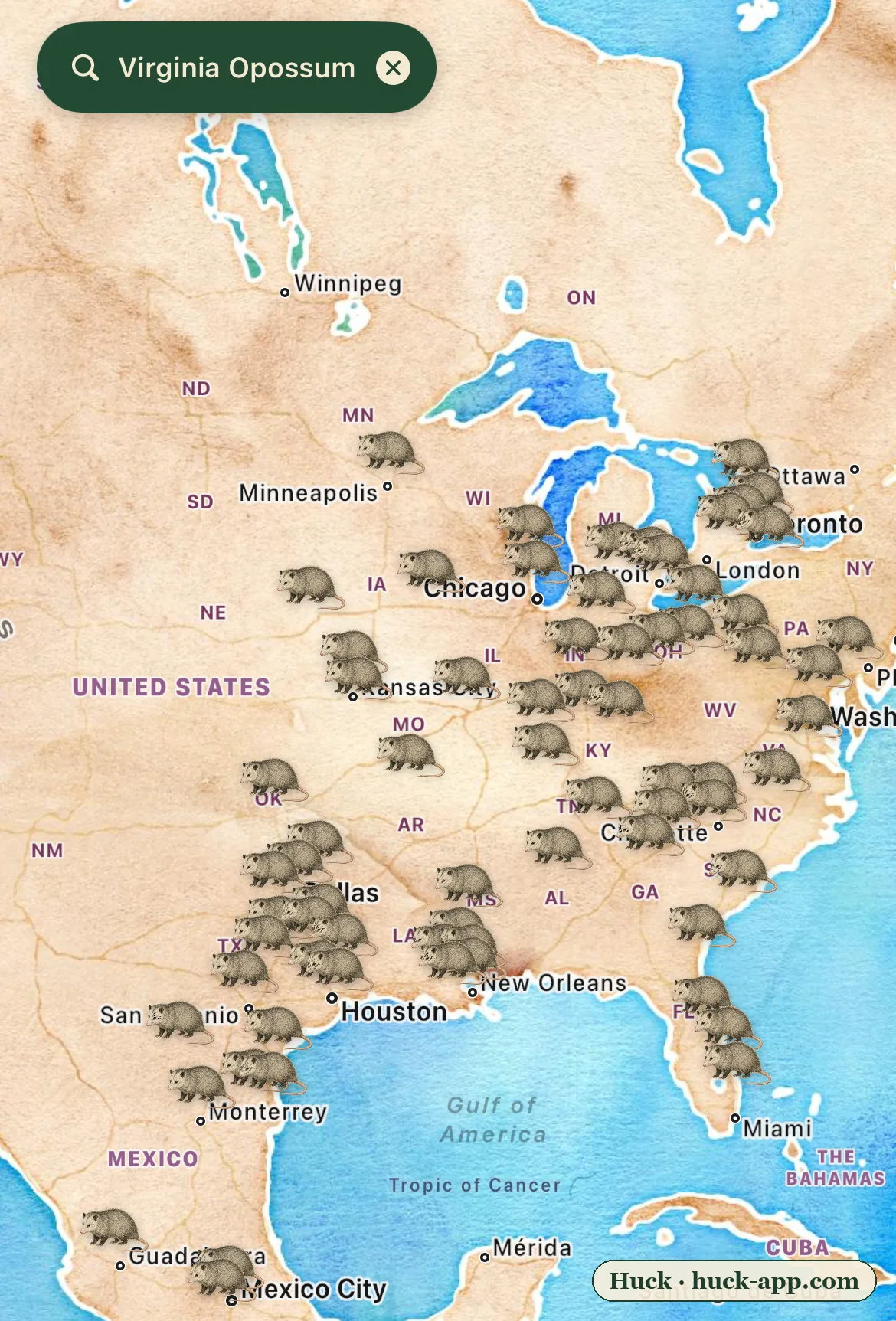
The opossum is the animal people love to hate: the hunched, drooling, hissing thing frozen in the headlights or hunched in the trash can, looking like a rat the size of a cat. It is almost none of the things its reputation says. It is North America’s only marsupial, a pouch-bearing oddity that wandered up from South America, and the map above shows it doing something quietly remarkable. Long a creature of the South, the Virginia opossum has spent decades pushing north, into the Great Lakes, New England, and Ontario, following our towns and our warmth.
The whole menace is a bluff
Everything frightening about an opossum is theater. Cornered, it gapes its mouth to flash all 50 teeth, the most of any land mammal in North America, and it hisses and drools until it looks genuinely dangerous. It almost never follows through. Push it past the bluff and it does the opposite of attack: it faints. Playing possum is not a clever act. It is an involuntary shock response, a catatonic collapse the animal cannot switch on or off, sometimes finished with a leaking, deathly smell, that can last minutes or hours. It is the least aggressive mammal in your yard doing an impression of the scariest.
Two things about it are almost superheroic
First, the opossum is largely immune to snake venom. It carries a peptide that neutralizes the venom of pit vipers, and researchers are studying that molecule as the basis for a universal antivenom. To an opossum a copperhead is mostly just dinner. Second, it almost never carries rabies. Its body runs cold, around 94 to 97 degrees, too cold for the rabies virus to take hold, so despite living cheek by jowl with us it is one of the last mammals you need to fear for it.
The tick myth its own fans get wrong
Here the internet overcorrects. You have probably seen the claim that a single opossum eats thousands of ticks a week and is a frontline soldier against Lyme disease. That figure came from one 2009 lab study, and a 2021 study that examined wild opossums found almost no ticks in their stomachs at all. The tick-hero story is probably a myth. The reassuring part is that the opossum does not need it: it earns its keep on slugs, snails, overripe fruit, carrion, cockroaches, and the occasional venomous snake, tidying the yard whether or not it is also eating your ticks.
What the map shows
The opossum was historically a southern animal, and the map shows how far that has shifted. It now turns up across New England, throughout the Great Lakes, into southern Canada, and along the Pacific coast, where it was introduced, while staying largely out of the cold, dry interior West. Cold is its real limit: its naked ears and bare tail are prone to frostbite, which is why northern opossums often look like their ears have been trimmed. Milder winters, and the food and shelter we leave out, keep nudging the top edge of its world further north.
Why to root for the drooling one
It is easy to recoil from an opossum. It is slow, it drools, it looks prehistoric, and it dies on our roads by the millions. But it is a harmless, ancient, venom-resistant, nearly rabies-proof survivor that asks nothing of you but the scraps, and it has been doing its quiet cleanup work here since long before there were people to be disgusted by it. The next time one freezes in your flashlight, swaying and drooling, you are looking at an animal that would genuinely rather faint than fight you. Let it shuffle off into the dark.
About the data
Sightings shown are research-grade community observations from iNaturalist, mapped in Huck; counts are current as of August 2026, and opossum coordinates are not obscured. The map reflects where people and phones are as well as where opossums are, but the northern spread it shows matches the documented, ongoing range expansion of the Virginia opossum. Venom-resistance, rabies, and tick claims draw on published research, including the 2009 and 2021 studies on opossum tick consumption.