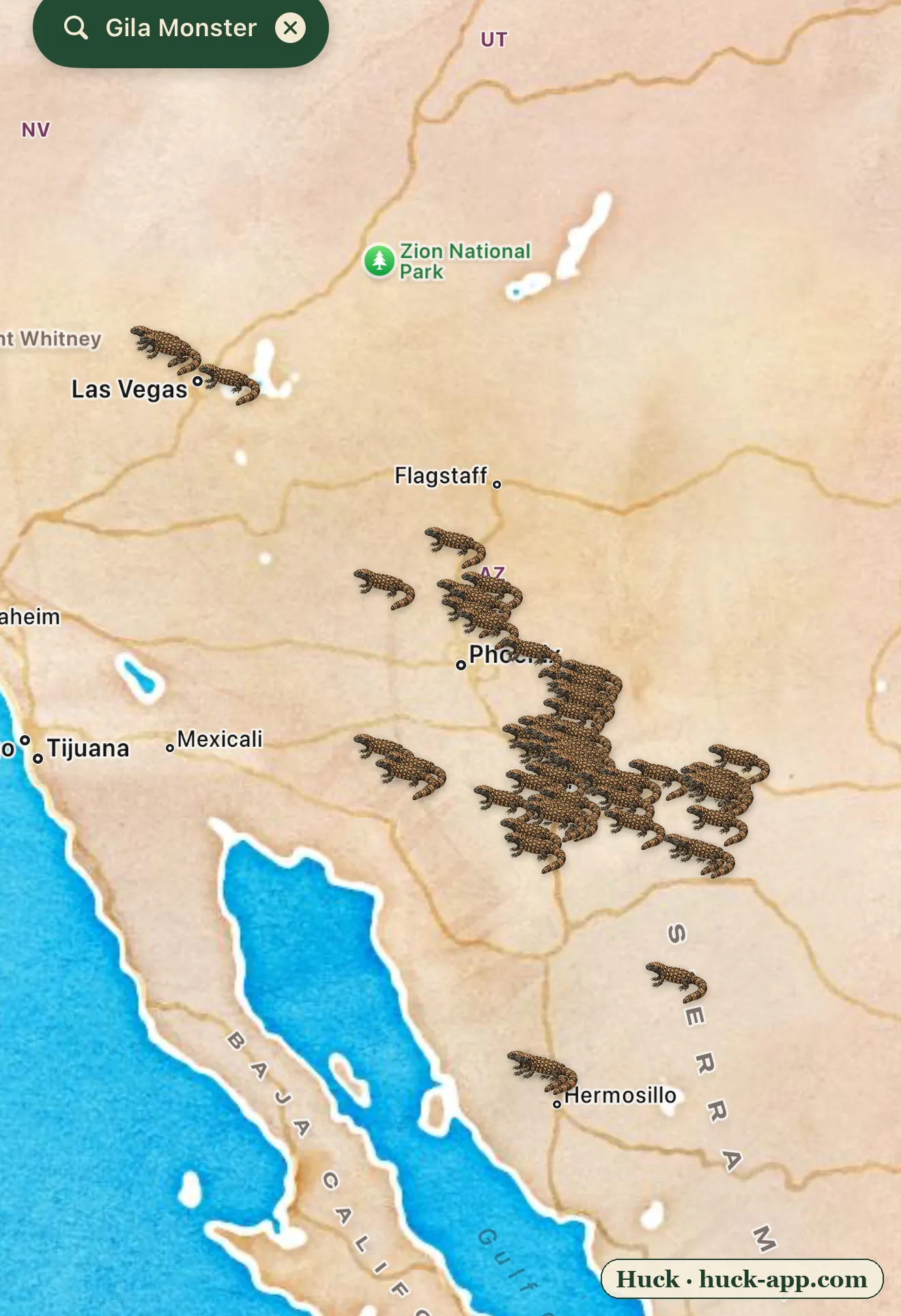
You have probably seen the claim go by: Ozempic comes from Gila monster venom. It is not quite true, and the real story is better than the myth. A slow, fat, venomous desert lizard that eats only a handful of times a year turns out to have carried, in its venom, the molecular blueprint for the biggest class of drugs in modern medicine. Here is what actually happened, and where this animal lives.
Meet the Gila monster
The Gila monster is the largest lizard native to the United States and one of only a handful of venomous lizards on Earth, a beaded, black-and-orange animal of the Sonoran and Mojave deserts. The map above is its world: central and southern Arizona above all, a corner of southern Nevada near Las Vegas, slivers of Utah, New Mexico, and California, and down into Sonora, Mexico. It is famously unhurried, spends the vast majority of its life underground, and does something strange with food: it gorges on enormous, rare meals, sometimes eating a third of its body weight at once and feeding only five to ten times in a year, storing the surplus as fat in its tail.
That feast-and-fast lifestyle is the clue. An animal that eats that rarely, that hugely, needs a way to manage its blood sugar across long stretches of nothing, and its body evolved chemistry to do it.
The endocrinologist and the venom
In the early 1990s, an endocrinologist named John Eng, working at a Veterans Affairs hospital in the Bronx, was studying reptile venoms. In Gila monster venom he isolated a peptide he called exendin-4, and he noticed it looked remarkably like a human hormone: GLP-1, which tells the pancreas to release insulin when blood sugar is high, slows the emptying of the stomach, and quiets appetite. Human GLP-1 has one problem as a drug: the body destroys it in about two minutes. The lizard’s exendin-4 did the same job and lasted for hours. Eng saw what he had, and when his employer would not pursue a patent, he paid for one himself.
From lizard to pharmacy
Synthesized as the drug exenatide and sold as Byetta, it was approved in 2005 as the first GLP-1 receptor agonist for type 2 diabetes. It lowered blood sugar without the crashes older drugs caused, and it did something that got everyone’s attention: patients lost weight. A peptide from a desert lizard had become a medicine.
Where the myth overshoots
Here is the honest part. Ozempic and Wegovy (semaglutide), and Mounjaro and Zepbound (tirzepatide), are not made from Gila monster venom. They are newer, synthetic molecules engineered around the human GLP-1 hormone, not the lizard’s exendin-4. So no, there is no lizard in your pen. But those drugs exist because the Gila monster proved the whole idea first: that a long-lasting GLP-1 mimic could safely reshape blood sugar and appetite. Exenatide opened the door. Ozempic and the rest walked through it. Every GLP-1 drug on the market today traces back to a peptide found in the venom of a lizard almost no one had a reason to study.
The part worth sitting with
There is a quiet irony on the map. The Gila monster, which seeded a class of drugs now worth well over a hundred billion dollars a year, is itself a protected animal, poached for the illegal pet trade and squeezed by desert development. Arizona made it one of the first venomous animals ever legally protected in the United States, back in 1952, long before anyone knew what was in its venom. That is the real lesson here. The value hidden in a wild species is not hypothetical, and it is not always where you would look. We found a blockbuster inside a lizard nobody was paying attention to. It is worth asking what else is out there, in the animals we are quietly losing.
About the data
Sightings shown are research-grade community observations from iNaturalist, mapped in Huck; counts are current as of August 2026. Gila monster coordinates are obscured by iNaturalist to protect the species from poaching, so those pins are approximate. The exendin-4 discovery and the development of exenatide (Byetta) are drawn from published accounts of Dr. John Eng’s work and the National Institute on Aging, and the relationship to later GLP-1 drugs reflects the scientific record.