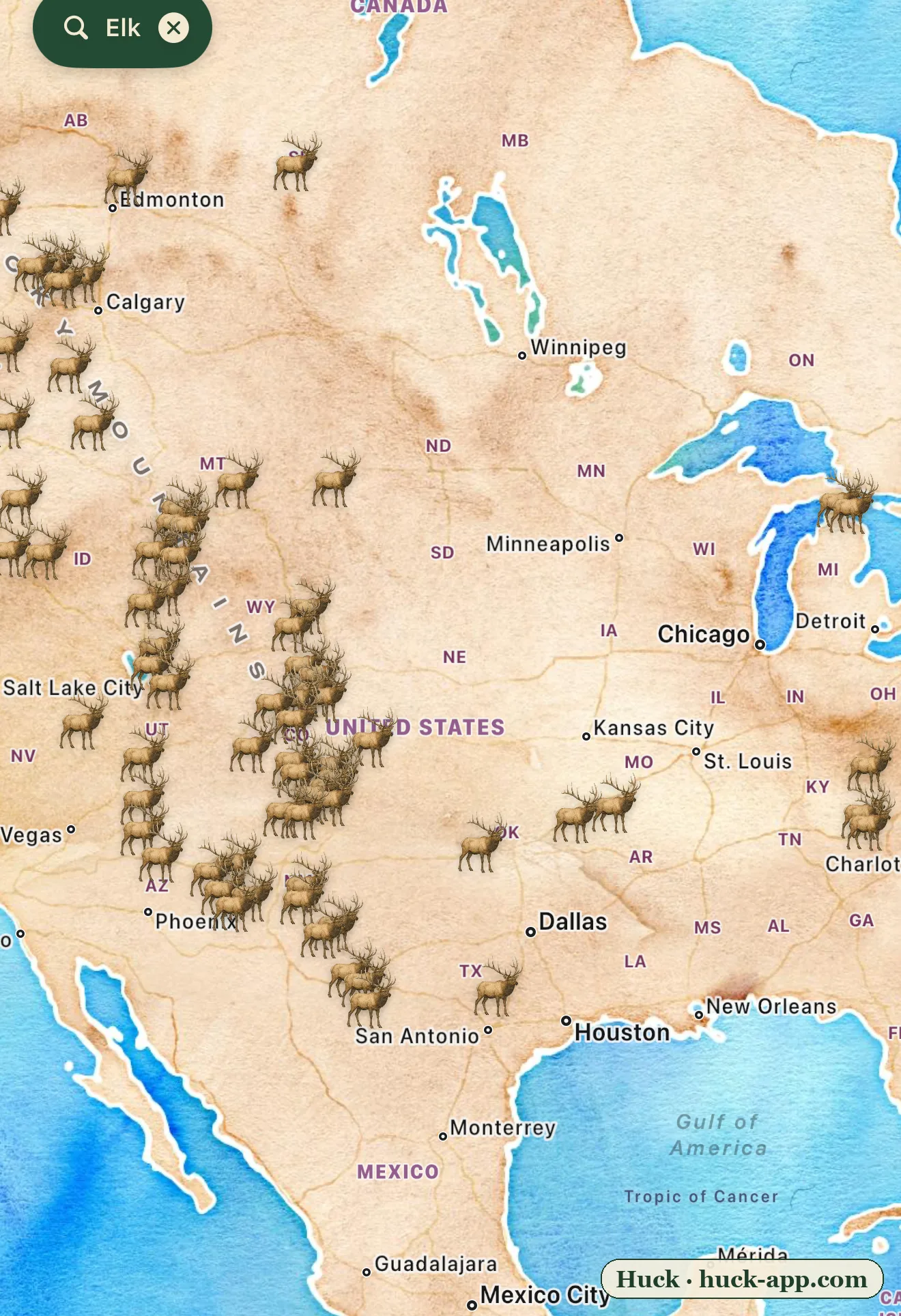
For a few weeks every fall the biggest members of the deer family in North America lose their minds, and if you stand in the right valley at dawn you can hear it happen. This is the elk rut, the breeding season, and it is peaking right now. The map above shows where to find it: a vast western stronghold through the Rockies, and a scatter of surprising eastern outposts where the whole spectacle was deliberately brought back from zero.
The sound
The bugle is the thing you go for. A rutting bull throws his head back and lets out a rising, unearthly scream that climbs into a high whistle and breaks into guttural grunts, and it carries across an entire valley. For an animal that can top 700 pounds it ought to roar; instead it sounds like something between a train whistle and a dinosaur, and the first time you hear it drifting out of the dark you do not forget it. Bulls bugle to advertise their size, hold together harems of cows, and warn off rivals, and when the sound is not enough they lock antlers and shove, a crack of bone you can hear across the meadow.
Where to go west
The classic western stages are the mountain meadows at first and last light. Rocky Mountain National Park around Estes Park, Colorado, is the most famous, where elk pour into the valleys and even the town at dusk. Yellowstone and the National Elk Refuge country in Wyoming are the other great theaters. The window is September into early October, dawn and dusk. Go quiet, and keep a long distance: a rutting bull is genuinely dangerous, and every single year visitors who crowd one for a photo get hurt. Let the sound come to you.
The eastern comeback on the map
Now look at the outposts far east of the Rockies. Elk once ranged across nearly the whole continent, eastern forests included, but by the late 1800s they had been hunted out of the East entirely, and the eastern elk was declared a distinct subspecies only after it was already extinct. What you see in the East today is a comeback done by hand: elk were reintroduced to the Great Smoky Mountains at Cataloochee, to the ridges of Pennsylvania, to eastern Kentucky’s reclaimed coal country, and to the Arkansas Ozarks along the Buffalo River. In those few valleys, a sound the East had not heard in more than a century now returns every autumn, and it draws crowds.
Not a big deer, a different animal
It helps to understand what you are looking at. A mature bull elk stands five feet at the shoulder and carries antlers that can span four feet and are grown from scratch, then shed, every single year. Through the rut the herd bull barely eats, spending his days and nights chasing off challengers and tending cows until he is worn to the bone, which is exactly why the rut is such a short, frantic window. Miss these few weeks and the mountains go quiet again until next fall.
What the community data shows
This map is built from roughly 49,000 research-grade elk observations on iNaturalist, with open coordinates, dense through the Rocky Mountains and the intermountain West and thinning to distinct islands in the East. Sightings track where people are too, but the split is the story: a western stronghold, and a few small eastern pockets that map, almost exactly, onto the places wildlife agencies chose to carry the animal back to.
About the data
Sightings shown are research-grade community observations from iNaturalist, mapped in Huck; counts are current as of September 2026, and elk coordinates are not obscured. The eastern extirpation and the modern reintroductions to the Great Smoky Mountains, Pennsylvania, Kentucky, and Arkansas are drawn from National Park Service and state wildlife agency records.