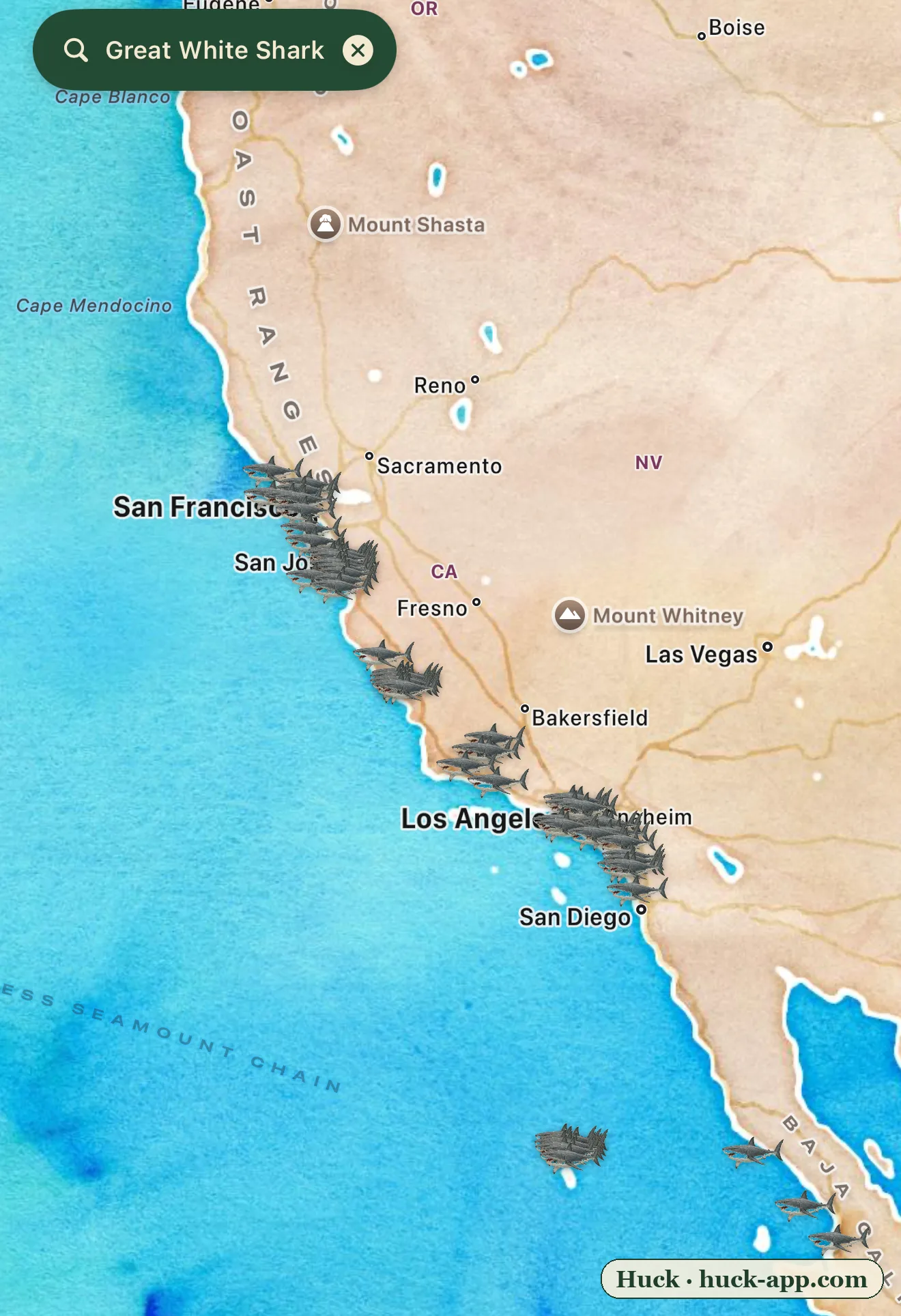
California is the other great white shark coast, and its map is stranger than Cape Cod’s. Plot the sightings and the state divides into two very different shark worlds with a quiet gap between them. Up north is the shark from the movies. Down south is the one almost nobody expects, and you have very likely swum near it without knowing.
Up north: the Red Triangle
The dense cluster around San Francisco is the Red Triangle, the stretch of coast running from Bodega Bay past the Farallon Islands down to Monterey. These are big adult white sharks, and they are here for the same reason Cape Cod’s are: seals. The Farallones and Año Nuevo hold enormous colonies of elephant seals and sea lions, and every fall the adult sharks arrive to hunt them, ambushing from below in the way that made the species famous. This is grown-up shark country, and it always has been.
Down south: a nursery full of babies
Now look at the southern band, from Santa Barbara through Los Angeles to San Diego. These are not the same animal. They are mostly juveniles, young white sharks a few years old, and they gather by the dozens in the warm, shallow water right off the beach, sometimes within yards of surfers and swimmers. Stretches of coast like Carpinteria, Padaro Lane, and Del Mar have become documented white shark nurseries, and drone surveys have found young sharks and people sharing the exact same surf zone on most days.
At some Southern California beaches, people and young white sharks share the same waves nearly every day, and almost nothing happens.
Here is the part that surprises people: those nursery beaches have not become more dangerous. Juvenile white sharks eat stingrays, halibut, and other fish, not people, and they mostly ignore the humans a few yards away. The researchers who track them, notably the Shark Lab at Cal State Long Beach, describe daily coexistence with almost no incidents. The young sharks are there for the warm water and the easy fish, and they appear to be spreading and lingering as the ocean warms, which is why the southern nurseries seem bigger and more permanent than they were a generation ago.
Two coasts, three stories
It makes a clean contrast with the East Coast. Cape Cod has essentially one kind of white shark: adults following a booming seal population. California has two at once, split by latitude and by age. The Red Triangle up north is the adult seal-hunters. The southern bight is the fish-eating juveniles. Same species, opposite ends of both the state and the shark’s life, and only one of them is the animal the movies taught you to fear.
What the community data shows
This map is built from roughly 389 research-grade white shark observations in California on iNaturalist, with open coordinates, and they cluster exactly where researchers say the sharks are: the Bay Area and Farallones in the north, the Santa Barbara-to-San-Diego bight in the south, and the rugged central coast quieter between. Community sightings track people too, and California’s crowded beaches and drone hobbyists mean plenty of eyes on the water, but the two-cluster pattern matches the science closely.
About the data
Sightings shown are research-grade community observations from iNaturalist, mapped in Huck; counts are current as of August 2026, and California white shark coordinates are not obscured. The northern seal-hunting aggregations and the southern juvenile nurseries are both well documented in published research, including tagging and drone work by the California State University Long Beach Shark Lab.